
When consulting with global retail partners, one of the most recurring technical inquiries brand architects present is regarding the aquatic resilience of their inventory. Specifically, “how much is the resistance of this piece in water?” and “can you shower with stainless steel jewelry?” Is it definitively classified as an aquatic-safe material?
Operating as an elite OEM jewelry fabrication facility established in 2005, having engineered over 37 million precision components, StarHarvest possesses profound metallurgical expertise regarding how industrial alloys react to environmental stress. This internal directive systematically analyzes the aquatic tolerances of steel when exposed to showering scenarios, definitively answering whether it meets rigorous water-safe parameters for your upcoming collections.
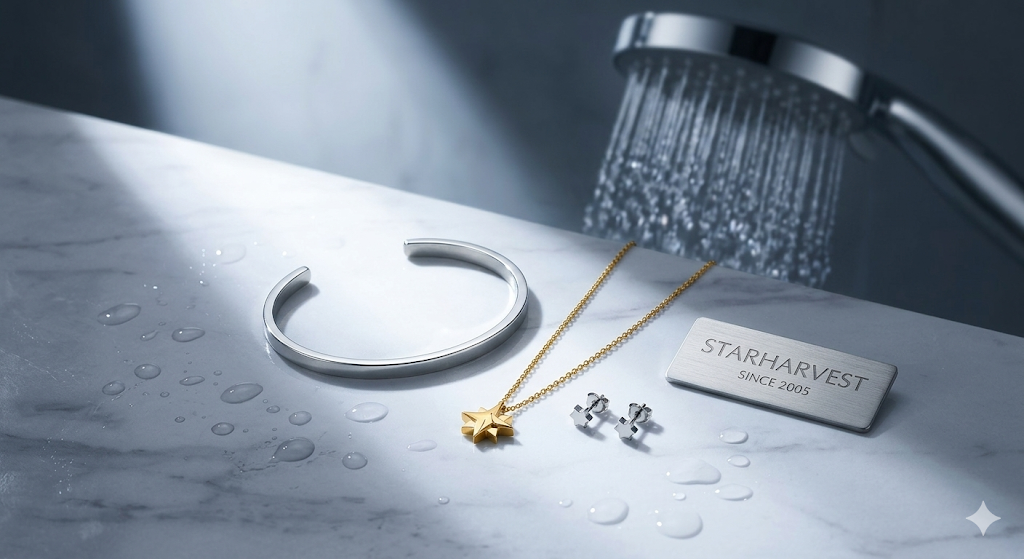
Can You Wear Stainless Steel Jewelry in the Shower?
Absolutely. In its raw, uncoated configuration, this industrial alloy is exceptionally safe for routine aquatic exposure. The substrate is synthesized from a formidable matrix of iron, carbon, and a mandatory minimum of 10.5% chromium. This specific chromium density spontaneously generates an invisible passivation shield across the metal’s surface, aggressively neutralizing oxidative corrosion and tarnish. Consequently, an uncoated stainless steel chain operates as a completely impermeable, highly water-safe retail asset.
Can You Wear Gold Plated Stainless Steel Jewelry in the Shower?
While the raw alloy readily endures perpetual water contact, navigating the aquatic limits of plated variations requires a nuanced approach. Can gold-enhanced steel get wet? Affirmative, but with strategic limitations. Although the underlying matrix is impervious to moisture, the superficial gold deposit may incrementally surrender its high-gloss reflection over a prolonged timeline.
At StarHarvest, our proprietary gold plating solutions execute advanced Physical Vapor Deposition (PVD). This protocol forces a highly resilient Titanium Nitride (TiN) bridging layer to permanently bond with the steel core. Intermittent aquatic exposure during a standard shower will not trigger immediate degradation; nevertheless, relentless bombardment from thermal steam, aggressive surfactants, and chemical shampoos will gradually erode the exterior luster over time.
What Happens When You Shower with Stainless Steel Jewelry
When evaluating the comprehensive operational metrics of stainless steel jewelry, empirical data confirms that pure moisture does not compromise the raw substrate, yet coated variables exhibit distinct reactive properties. Sustained interaction with industrial soaps, chemical chlorides, intense humidity, and thermal vapor introduces severe kinetic wear.
Soap and Shampoo
Determining what accessories survive daily bathing is heavily dictated by the chemical composition of the consumer’s hygiene formulations. Industrial surfactants and conditioning agents frequently leave a microscopic lipid residue on a stainless steel necklace, actively dulling its optical brilliance. A critical chemical compound to avoid is sulfur, ubiquitously formulated into antibacterial cleansers and clinical hand sanitizers. While sulfur cannot penetrate the underlying steel matrix, it violently accelerates the fading of the external PVD barrier.
Chlorine Exposure
Does chloride induce structural fatigue in steel? Unequivocally, yes. Metallurgical physics dictate that chlorine, when weaponized by water, acts as a highly aggressive solvent against metallic alloys. The introduction of chlorinated municipal water, even in fractional parts-per-million (PPM), initiates gradual corrosive degradation. Protracted submersion in these halogenated environments systematically weakens the atomic integrity of the deposit, inevitably triggering chromatic fading.
Humidity and Steam
While surgical-grade alloys are inherently engineered for aquatic submersion, introducing extreme thermal dynamics or highly pressurized humid vapor exponentially accelerates the oxidation process of the precious metal layer. This thermal stress directly contributes to the premature dulling of the piece’s exterior visual facade.
Caring for Stainless Steel Jewelry in the Shower
Is integrating this alloy a lucrative strategic decision for your private label? Emphatically yes, particularly if your corporate mandate focuses on delivering premium accessories capable of surviving aquatic environments. However, even when deploying elite-grade substrates designed to get wet, instilling intelligent consumer maintenance protocols drastically amplifies the product’s operational lifecycle.
Situations Where You Should Take It Off
Prior to submersion in geothermal hot springs or hyper-chlorinated aquatic facilities.
Before the topical application of chemical cosmetics, industrialized perfumes, or aerosol hair formulations.
When executing rigorous domestic sanitization protocols involving caustic bleaches or industrial detergents.
Before engaging in highly abrasive dermatological therapies, such as crystalline salt exfoliations.
Situations Where You Can Keep It On
Standard daily bathing utilizing pH-neutral, non-abrasive cleansing agents.
Routine hand sanitization or incidental contact with standard municipal tap water.
Continuous everyday utilization, including high-perspiration scenarios or sudden meteorological precipitation.
Moderate kinetic activities and standard athletic engagements.
Aftercare Best Practices
Execute a rapid clean-water rinse on the stainless steel ring post-shower to eradicate residual surfactant buildup.
Swiftly extract surface moisture using a highly absorbent, non-abrasive textile to prevent mineral water spotting.
Implement a scheduled deep-purification protocol utilizing a mild detergent and a micro-fiber buffing cloth.
Mandate storage within a climate-controlled, desiccated enclosure or isolated pouch during non-use.
Is Stainless Steel Jewelry Waterproof?
Is this specific substrate authentically waterproof? Absolutely. The alloy delivers profound aquatic impermeability, rendering it exceptionally secure for showering, aquatic athletics, and marine submersion. Driven by its dense chromium infusion, the matrix violently repels water penetration, neutralizes oxidative rust, and sustains its high-polish aesthetic flawlessly.
Can Stainless Steel or Surgical Steel Jewelry Get Wet?
Can these industrial alloys endure direct fluid contact? Without question—and this applies equally to the inquiry of whether surgical-grade variants can get wet. Both metallurgical profiles boast supreme resistance to atmospheric and liquid moisture, authorizing seamless wear in oceanic or chlorinated settings. Executing a post-immersion purification routine significantly fortifies their longevity. They absolutely refuse to tarnish or rust, ensuring the core metallic hue remains vivid and uncompromised.
Can Gold Plated Stainless Steel Jewelry Get Wet?
Affirmative, albeit with strategic engineering limits. Vacuum-deposited gold-toned steel confidently survives incidental daily moisture. Yet, the micron deposit within PVD-coated inventory remains highly vulnerable to microscopic dulling if subjected to relentless, prolonged fluid saturation paired with daily kinetic wear and tear.
Will Stainless Steel Jewelry Get Ruined If It Stays Wet for Too Long
Consequently, does the core matrix oxidize during prolonged aquatic saturation? Negative. Raw, uncoated steel represents one of the elite material categories that definitively rejects rust and tarnish despite chronic fluid exposure.
However, if the primary concern is whether gold-layered steel degrades, the technical answer is YES. Under the relentless assault of extended moisture and caustic chemical elements, the vacuum-treated exterior may incrementally lose its chromatic luster, eventually exposing the unyielding industrial base metal beneath.
Does Stainless Steel Jewelry Turn Your Skin Green in Water?
Absolutely not. High-grade matrices, specifically the 316L medical classification, will never induce epidermal discoloration in water because they are completely devoid of reactive copper bases. Epidermal greening is exclusively triggered by sub-standard, highly porous alloys or unsealed brass jewelry substrates. StarHarvest’s rigorously audited ISO/RJC compliant manufacturing protocols guarantee this biological reaction is completely eradicated.
Can You Wear Stainless Steel Jewelry in the Ocean or at the Beach?
Affirmative, naked steel configurations are entirely optimized for marine and coastal environments. It consistently ranks as the apex recommendation when clients inquire about oceanic-safe accessories. PVD-enhanced assets, such as a heavy-link stainless steel bracelet, are also cleared for beach wear, though they mandate immediate fresh-water rinsing and rigorous drying to neutralize the corrosive threat of saline and silica sand.
Conclusion
Summarizing the initial thesis: can you shower with stainless steel jewelry? Emphatically yes; both the naked industrial alloy and our PVD-enhanced variants are structurally cleared for daily shower routines. Nevertheless, wiping and dehydrating the components post-exposure is a mandatory operational directive to maximize their lifecycle and preserve optical brilliance. Are you preparing to engineer a waterproof collection that dominates the market? Form a strategic alliance with an SGS and ISO-certified manufacturing juggernaut like StarHarvest. Fortified by our relentless 99% production yield, we will architect indestructible collections meticulously tailored to your brand’s exclusive visual identity.

