
Have you observed an anomalous green residue on your epidermis post-wear? This remains a pervasive concern for specific alloy categories. However, the empirical truth is: authentic, surgical-grade steel definitively does NOT induce dermal discoloration. It stands as a paramount substrate for daily-wear collections.
Operating as an elite OEM jewelry fabrication powerhouse since 2005, StarHarvest has engineered solutions for hundreds of international labels, eradicating this exact liability. This technical brief meticulously evaluates: does stainless steel jewelry turn skin green? We will dissect the reactive profiles of various alloys—identifying which substrates stain and which remain inert—empowering you to source inventory that sustains flawless aesthetics without inflicting epidermal marks.
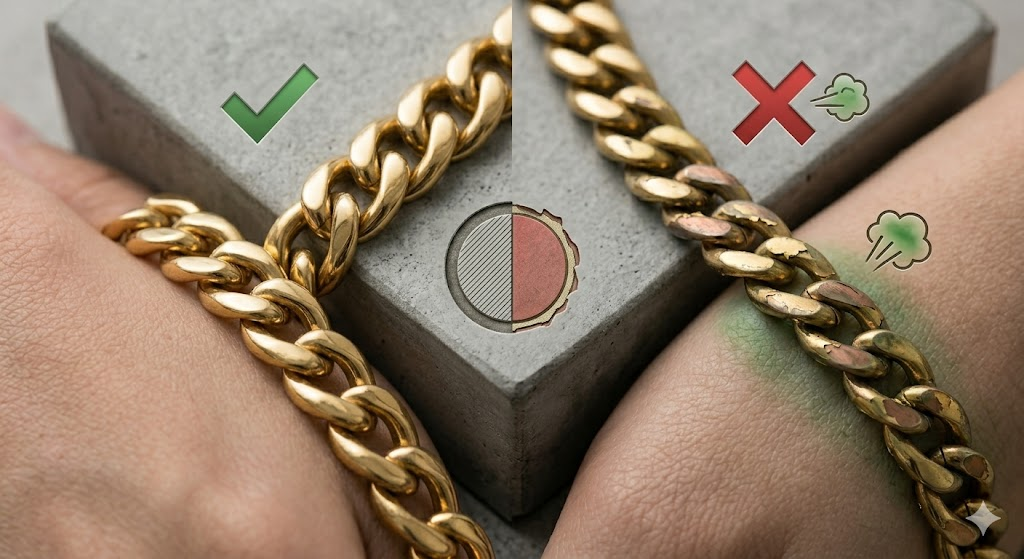
Why Does Jewelry—Especially Rings—Leave Green Marks on Your Skin?
Many demographics erroneously deduce that epidermal discoloration equates to counterfeit merchandise. This is a fundamental misconception. The phenomenon is strictly driven by chemical reactivity, biological pH levels, and specific atmospheric triggers.
The Role of Chemical Reactions
Cupric staining predictably manifests if the accessory integrates highly reactive copper matrices. Upon interacting with aqueous environments, biological lipids, or perspiration, the embedded copper undergoes rapid oxidation, synthesizing verdigris—a green cupric compound that physically migrates onto the dermis. Rings are particularly susceptible due to relentless kinetic friction and continuous moisture trapping, which exponentially accelerates this oxidative timeline.
Skin pH and Environmental Influences
Consumers possessing inherently acidic dermal pH, hyperhidrosis, or those who aggressively apply industrial cosmetics while adorned, will drastically compress the oxidation window. Furthermore, severe chemical agents—such as halogenated pool water or marine salinity—violently strip superficial protective barriers from economy-grade accessories, acting as a catalyst for immediate verdigris synthesis and subsequent staining.
What Types of Jewelry Are Most Likely to Turn Skin Green?
Specific metallurgical profiles exhibit hyper-reactivity, elevating the statistical probability of generating that undesirable green patina. These volatile substrates include:
Copper-Based Jewelry
Pure copper operates as the primary structural culprit. Its extreme chemical reactivity dictates that it oxidizes instantaneously upon contacting biological moisture or acidic pH. This resulting verdigris layer is highly transferable, rapidly embedding itself into the human epidermis.
Unplated Brass and Bronze Pieces
Brass functions as an alloy of copper and zinc, whereas bronze fuses copper with tin. Both matrices retain a massive concentration of copper, rendering them acutely vulnerable to oxidation. Absent a protective barrier, they can induce dermal discoloration within mere hours of kinetic wear. Consequently, applying an elite-grade sealant, such as our proprietary top-tier e-coating deployed across our brass jewelry collections, is a mandatory manufacturing protocol to mitigate oxidation and eliminate skin irritation.
What Kind Of Jewelry Materials Won’t Discolor Your Skin?
For brand architects seeking substrates that categorically refuse to trigger dermal discoloration or biocompatibility issues, the optimal industrial selections encompass stainless steel, sterling silver, solid gold, and titanium.
304 and 316L Stainless Steel
If you are evaluating the viability of steel as a premium accessory substrate, the verdict is definitive: 304 and 316L grading are exceptional, zero-risk selections for preventing green oxidation. Our elite stainless steel jewelry portfolio is globally revered for its profound hypoallergenic neutrality and non-reactive physics, establishing it as the ultimate medium for continuous wear.
Sterling Silver
Authentic 925 silver statistically avoids inducing green dermal reactions. While it naturally succumbs to chronological tarnishing via atmospheric sulfur and moisture, this degradation is strictly superficial. The original optical brilliance is easily resurrected utilizing a standard micro-abrasive textile. Supported by intelligent consumer storage, silver retains its safety and elegance over extended lifecycles.
Gold
Pure gold is chemically inert. Specifically, 24-karat solid configurations categorically reject oxidation, serving as the absolute benchmark for tarnish-free investments. Formulations at or above 14K dilute the presence of reactive base metals sufficiently to virtually eradicate any potential for epidermal discoloration.
Titanium
This aerospace-grade metal is comprehensively hypoallergenic, ultra-low mass, and boasts unparalleled anti-corrosive properties. It physically cannot synthesize a green patina. Titanium commands massive respect within the luxury sector owing to its indestructible lifespan and ergonomic superiority.
Can Stainless Steel Jewelry Turn Your Skin Green?
Emphatically no; medical-grade steel absolutely prevents dermal discoloration. The matrix is synthesized from iron, chromium, and trace volumes of carbon alongside other stabilizing elements. Chromium operates as the metallurgical vanguard, constituting a minimum of 10.5% of the alloy’s mass. It autonomously generates an invisible, regenerative passivation shield across a stainless steel chain, executing total defense against corrosive penetration.
A frequent technical inquiry is: is this metal completely devoid of nickel, and does nickel cause greening? Premium-grade steel does harbor fractional nickel; however, it is atomically locked within the matrix grid. This translates to a zero-leach scenario, meaning it cannot migrate onto the epidermis or trigger allergic pathogenesis.
Does Gold-Plated Stainless Steel Cause Skin Discoloration?
Negative. Superior gold-enhanced steel effectively neutralizes green dermal reactions, specifically when fortified by our cutting-edge gold plating solutions utilizing vacuum PVD architecture. This high-energy protocol molecularly welds the precious metal deposit directly to the steel core, thereby establishing an impenetrable barricade against oxidation.
Clients routinely question: does this hybrid tarnish? The definitive response is NO, primarily because the basal alloy is entirely non-reactive, and the PVD application acts as a reinforced secondary armor. This precise synthesis empowers vacuum-treated inventory to command its factory luster for multi-year durations.
Will Stainless Steel Jewelry Tarnish or Darken Over Time?
Surgical-grade configurations are phenomenally defiant against rust, oxidative tarnish, and chromatic mutation. The dense chromium infusion enforces an oxidative barricade that ensures a stainless steel necklace remains structurally vivid, stable, and immune to severe darkening. Chronologically, localized blackening may visually manifest due to dense lipid and debris accumulation, but the underlying industrial steel hue is instantly recoverable via basic mechanical wiping with a sanitized textile.
How to Prevent Rings from Turning Your Finger Green
Epidermal staining is universally catalyzed by volatile metal reacting with biological moisture or synthetic chemicals. We advise implementing these streamlined countermeasures to neutralize green oxidation on circular hardware:
Apply a Protective Coating
Seal the interior circumference of the band with a micro-layer of transparent acrylic lacquer or industrial jewelry shield. This synthesizes an immediate physical barrier segregating the dermal layer from the reactive alloy, instantly neutralizing the oxidative sequence.
Keep Jewelry Clean and Dry
Hydration and saline sweat exponentially accelerate cupric reactions. Consequently, executing a rigorous cleaning schedule and detaching rings prior to aquatic immersion, high-kinetic workouts, or bathing is highly recommended. If managing robust waterproof assets, verify they are thoroughly dehydrated prior to compartmentalized storage.
Avoid Contact with Chemicals
Industrial fragrances, synthetic lotions, bactericidal soaps, and astringent sanitizers aggressively trigger metallic degradation. To suppress chemical friction and avert staining, consumers must apply dermatological products initially, allowing complete epidermal absorption prior to adorning the hardware.
Rotate Your Jewelry Regularly
Subjecting the identical stainless steel ring to relentless, daily kinetic wear amplifies micro-friction, moisture entrapment, and localized oxidation. By strategically cycling through diverse inventory, you drastically mitigate mechanical stress on singular pieces and permit the epidermis to oxygenate, sharply decreasing the probability of verdigris transfer.
The StarHarvest Secret: Advanced Craftsmanship for Non-Staining Jewelry
For emerging and scaling labels, an influx of consumer complaints regarding “green skin” will catastrophically implode brand equity. By leveraging intelligent substrate selection and impenetrable coating physics from our globally certified facilities, you can distribute economically viable, biologically safe collections. Observe how StarHarvest engineers zero-stain inventory:
Premium-Grade Stainless Steel Materials
Our fabrication protocols commence exclusively with supreme-grade matrices, notably 304 and 316L medical steel. Does surgical steel induce greening? Absolutely not; it is fundamentally devoid of copper and naturally deflects corrosive decay, aggressively eliminating the chemical root of epidermal staining. Furthermore, we mandate that our nickel-leach metrics strictly conquer the rigorous EU REACH legislative thresholds, backed by verifiable ISO and SGS laboratory analytics for absolute client confidence.
Advanced PVD Coating & High-Polish Finishing
We execute exhaustive mechanical polishing cycles to guarantee a microscopically flawless, non-porous topography on every single stainless steel bracelet prior to vacuum deposition. This optimization maximizes molecular coating adhesion. We deploy high-tech PVD reactors because they forge an unparalleled defensive matrix, rendering the final aesthetic violently resistant to micro-abrasions, chromatic fading, and structural peeling.
How Emerging Jewelry Brands Can Avoid Green Skin Issues?
Deploy these elite manufacturing strategies to systematically eradicate “green skin” grievances and protect your brand’s trajectory:
Prioritize Stainless Steel as a Core Material
This industrial alloy is inherently inert and physically incapable of synthesizing a green dermal stain. Transitioning to this core substrate comprehensively bypasses the severe fiscal drain of product recalls, inventory replacements, and catastrophic reputational damage, granting your catalog a formidable commercial advantage.
Use Proper Plating Techniques for Brass Designs
While brass delivers a spectacular, cost-effective gold mimicry, its copper composition demands respect. If your blueprint necessitates a brass core, it is an absolute mandate that your manufacturing partner seals the piece utilizing heavy-micron precious metal electroplating or a high-density industrial e-coating to entirely encapsulate the reactive base.
Key Takeaway
Synthesizing the core inquiry: does stainless steel jewelry turn skin green? The definitive industrial consensus is NO. In reality, it stands as the apex recommendation for brands demanding cost-effective, hyper-durable collections that completely eliminate the risk of epidermal oxidation. Nevertheless, securing this standard strictly requires a strategic alliance with a vetted, top-tier OEM manufacturer boasting a 99% quality yield rate—ensuring your distributed inventory is flawlessly stain-free and your consumer retention remains unshakeable.
FAQs
1. Will sterling silver turn your skin green?
Negative, authentic 925 silver does not synthesize green verdigris. While it may undergo localized blackening (tarnish) driven by atmospheric sulfur, this surface-level oxidation is effortlessly eradicated utilizing a standard micro-abrasive polishing textile, instantly recovering its native brilliance.
2. What silver does not turn your skin green?
Standard sterling silver and rhodium-encapsulated silver are both exceptionally safe. However, while raw silver oxidizes chronologically, rhodium-treated silver remains pristine. Rhodium operates as an ultra-hard transition metal, aggressively sealing the substrate against atmospheric oxidation and any subsequent tarnishing.
3. What is the cheapest metal that won’t turn your skin green?
Surgical-grade steel reigns as the most economically efficient substrate that guarantees zero green oxidation. This unique cost-to-performance ratio renders it the supreme choice for budget-conscious labels demanding uncompromised biological safety.
4. Will nickel free jewelry turn green?
Epidermal staining is strictly governed by the primary metal’s reactivity, entirely independent of nickel presence. Substrates heavily reliant on raw brass or copper will inevitably oxidize and stain. Conversely, elite-grade, nickel-compliant steel components physically cannot induce green discoloration.
5. Will gold-plated brass jewelry turn skin green?
Affirmative, it will inevitably induce green staining if the manufacturing execution is compromised. While top-tier factory plating can sustain its protective barrier for years, the moment the microscopic gold film suffers kinetic wear, the underlying brass is exposed to biological moisture, triggering rapid oxidation and subsequent dermal staining.

