
Is surgical-grade steel susceptible to oxidative decay? Absolutely not. 316L medical-grade steel is engineered for indefinite longevity—fiercely resisting corrosion, chromatic fading, and environmental tarnish despite rigorous daily friction. As an elite OEM jewelry manufacturing facility established in 2005, StarHarvest has engineered over 37 million premium components for international labels. Within this technical dossier, we disseminate the empirical metallurgical facts, strategic commercial benefits, and lifecycle maintenance protocols of surgical steel to validate its zero-tarnish supremacy.
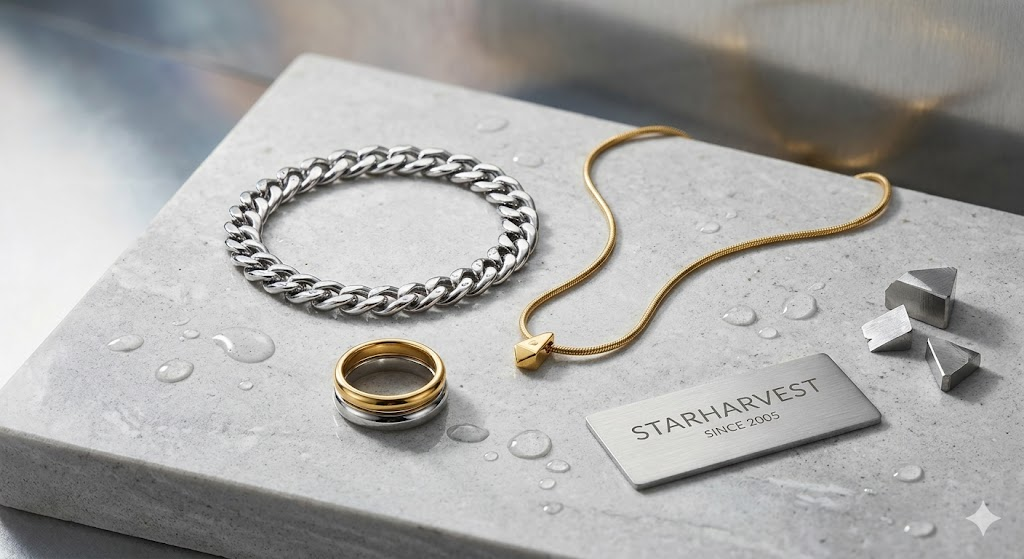
What Is 316L Surgical Steel Jewelry?
Defining this substrate requires looking at its atomic architecture. Commonly classified as 316L stainless steel, this hyper-refined matrix is predominantly iron, infused with 16-18% chromium, 10-14% nickel, and a critical 2-3% of molybdenum. Is this specific grading viable for commercial retail collections? Emphatically yes. The “L” denotes an ultra-low carbon footprint (restricted below 0.03%), which acts as the primary mechanical defense mechanism granting this premium alloy its indomitable resistance to oxidation.
What Is Gold Surgical Steel Jewelry?
This hybrid configuration masterfully synthesizes the absolute mechanical toughness of a 316L core with the opulent facade of genuine gold. This union is technically executed by depositing a true karat layer over the steel base. Operating at StarHarvest, our proprietary gold plating solutions deploy vacuum-sealed physical vapor deposition (PVD) to ensure this molecular bond is virtually indestructible. Is the exterior genuinely authentic? Yes, the underlying matrix is industrial-grade steel, while the exterior flash is 100% authentic gold.
Does 316L Surgical Stainless Steel Jewelry Tarnish?
When brands evaluate which metallurgical options definitively repel tarnish, surgical-grade steel ranks at the absolute apex. The elevated chromium ratio spontaneously synthesizes a microscopic, impenetrable oxide barricade that rigorously repels discoloration and rust. Contrasting drastically with porous metals that absorb environmental lipids, cosmetics, or moisture, surgical steel’s hyper-dense atomic structure neutralizes tarnish development perpetually. This dynamic establishes it as the ultimate foundational substrate for any highly durable stainless steel jewelry portfolio.
Does Gold Surgical Steel Tarnish or Fade?
The chromatic endurance of gold-coated surgical steel is entirely contingent upon the factory’s deposition protocols. Collections engineered with elite PVD vacuum gold integration flawlessly retain their high-gloss facade for a minimum of one to two years, often vastly longer. Conversely, units subjected to rudimentary, thin-film electro-chemical baths suffer rapid chromatic failure. For ambitious labels, mandating PVD-treated 316L substrates from a veteran facility like StarHarvest guarantees the simultaneous delivery of luxury aesthetics and unbreakable structural fortitude.
Does 316L Stainless Steel Contain Nickel? Is It Harmful to People?
Affirmative, the 316L matrix inherently integrates a fractional percentage of nickel. However, this metric does not equate to biological toxicity. The critical industrial metric is the nickel release rate, rather than baseline content. 316L surgical steel exhibits a near-zero release metric—drastically plummeting below the highly restrictive EU REACH mandate of 0.5 μg/cm²/week. This extraordinary stability renders it profoundly safe for demographics with acute dermatological sensitivities, which perfectly justifies its ubiquitous deployment in internal medical implants.
Is Stainless Steel the Same as Surgical Steel Used in Jewelry?
Categorically, no. While both occupy the same overarching alloy family, surgical steel—explicitly the 316L variant—is a highly purified, biocompatible iteration boasting exponentially superior defenses against corrosive decay compared to the baseline 304 grading. It delivers uncompromised mechanical performance, ensuring that its fractionally higher fabrication COGS (Cost of Goods Sold) translates into a massively profitable investment for high-end retail collections.
Benefits of Surgical Steel
This medical-grade alloy furnishes a multitude of strategic commercial advantages, positioning it as the apex material for labels demanding indestructible, high-margin accessories.
Resistance to Corrosion and Tarnishing
Does 316L degrade? Never. The precise chromium infusion combined with our immaculate PVD gold coating protocol empowers the matrix to withstand catastrophic environmental corrosion. The substrate autonomously generates an invisible oxide armor, actively combating rust, visual deterioration, and chemical decay.
Ideal for Sensitive Skin Customers
This alloy represents the most reliable compliance solution for rigorous EU/US market entry. Boasting supreme hypoallergenic and biocompatible traits, it provides a safe haven for highly reactive consumers. Its clinically low nickel release and medical-grade sterilization thoroughly eradicate the risk of contact dermatitis.
Durability
The extreme density and tensile rigidity of this compounded alloy violently reject surface abrasions, micro-denting, and kinetic warping. This unsurpassed toughness is perfectly calibrated for relentless daily usage. A substantial stainless steel bracelet, for example, will endure a lifetime of rigorous physical exposure without compromising its geometric architecture.
What Types of Jewelry Are Recommended for Surgical Steel?
The highly specialized metallurgical profile of surgical steel renders it the mandatory choice for specific accessory categories, particularly where inferior alloys face catastrophic failure:
Jewelry for Body Piercings
Certified for medical deployment, this is the undisputed zenith for piercing hardware. It provides absolute biological safety for unhealed puncture wounds and perpetual internal wear. Its frictionless, non-porous topography inhibits microbial colonization, drastically accelerating the dermal healing timeline.
Children’s Jewelry Collection
Infant demographics exhibit severe vulnerability to metallurgical toxins. Surgical steel’s absolute hypoallergenic purity guarantees zero adverse biological reactions. Furthermore, its extreme impact resistance completely neutralizes kinetic damage sustained during rigorous adolescent play or frequent aquatic exposure.
Permanent Jewelry
This alloy perfectly suits the explosive permanent jewelry sector, where components are thermally micro-welded, circumventing traditional locking clasps. The matrix’s supreme tensile strength prevents weld-point fracturing, empowering a continuous stainless steel chain to deliver flawless, perpetual ergonomic wear.
Earrings
Piercing posts engineered from 316L steel remain the safest protocol for highly reactive earlobes. The frictionless finish and total biocompatibility obliterate inflammation. A frequent consumer inquiry is: “Will surgical steel earrings tarnish?” The definitive response is no; the chromium shield repels oxidative discoloration indefinitely.
How to Clean Surgical Steel Jewelry?
While this medical-grade substrate requires practically zero maintenance, periodic purification dramatically revitalizes its optical brilliance. Disseminate this rapid 5-phase protocol to your consumer base:
Step 1: Prepare Soapy Water
Submerge a shallow receptacle with lukewarm purified water, introducing a fractional dose of pH-neutral, non-abrasive detergent.
Step 2: Soak the Jewelry
Completely immerse the components into the aqueous solution, allowing the surfactants to dissolve lipid buildup for exactly 10 to 15 minutes.
Step 3: Gently Brush
Deploy a micro-bristle apparatus to delicately agitate the surface geometry, effectively dislodging any stubborn microscopic debris from complex settings.
Step 4: Rinse and Dry
Execute a comprehensive rinse of the stainless steel necklace or intricate stainless steel ring beneath active, clean water. Rapidly extract moisture using a high-absorption, lint-free textile.
Step 5: Polish and Store
To restore absolute factory luminosity, gently buff the surface utilizing a microfiber cloth in continuous circular motions. Isolate the asset within a desiccated, climate-controlled jewelry compartment.
Conclusion
Readdressing the core thesis: does surgical steel jewelry tarnish? Absolutely not. Forged from an indestructible industrial base and sealed with a hyper-durable PVD gold barrier, it stands as the ultimate commercial solution for brands demanding visually arresting, lifetime-wear collections. However, catastrophic failure remains possible if the fabrication is executed by unverified suppliers deploying substandard films. Consequently, securing your supply chain through a globally vetted OEM powerhouse like StarHarvest—armed with SGS/ISO compliance and a relentless 99% production yield—is a strict commercial imperative.
FAQs
1. Is Stainless Steel Tarnish-free?
Affirmative, the alloy is entirely tarnish-resistant. The embedded chromium spontaneously generates a microscopic passivation layer, halting oxidation and preserving peak surface luminosity despite relentless daily friction and negligible upkeep.
2. Is Surgical Steel Good for Piercing?
Unquestionably. Medical authorities globally endorse this matrix due to its hyper-smooth, non-porous exterior, which aggressively thwarts bacterial adhesion and optimizes the tissue regeneration cycle.
3. Does 316L Surgical Steel Contain any Nickel?
Yes, nickel is present within the compound. However, the ionic release rate is mathematically negligible, rendering it incapable of triggering dermal allergies. Its classification as a medical-grade matrix guarantees uncompromising biological safety.
4. Can You Wear Surgical Steel in the Shower?
Absolutely. It represents the apex material for aquatic immersion, functioning flawlessly in chlorinated pools and oceanic environments. Its profound anti-corrosive architecture deflects prolonged exposure to water and commercial hygiene products.
5. How Long Does 316L Stainless Steel Last?
In its raw, unplated configuration, 316L steel offers infinite, multi-generational longevity. When enhanced with PVD vacuum coating, the chromatic finish easily surpasses 2 years of continuous, zero-tarnish wear, provided basic consumer care protocols are maintained.
6. Is Surgical Steel Better than Sterling Silver?
Both substrates fulfill highly distinct strategic mandates. However, from an operational perspective, surgical steel delivers vastly superior affordability, total tarnish immunity, higher kinetic durability, and elevated hypoallergenic safety when compared to silver or standard brass jewelry formulations.

