
Does stainless steel jewelry harbor nickel? The technical answer is affirmative. However, contrary to prevalent consumer misconceptions, although nickel is present within the metallurgical matrix, the piece can be definitively classified as “nickel-free” provided its ionic release remains beneath internationally mandated safety thresholds.
Fundamentally, the mere presence of nickel in the alloy does not equate to biological hazard. The decisive metric is the rate of nickel release into the dermis. Operating as a premier OEM jewelry fabrication powerhouse since 2005, StarHarvest demystifies the industrial definition of “nickel-free” and identifies the high-integrity materials your brand can trust for global compliance.
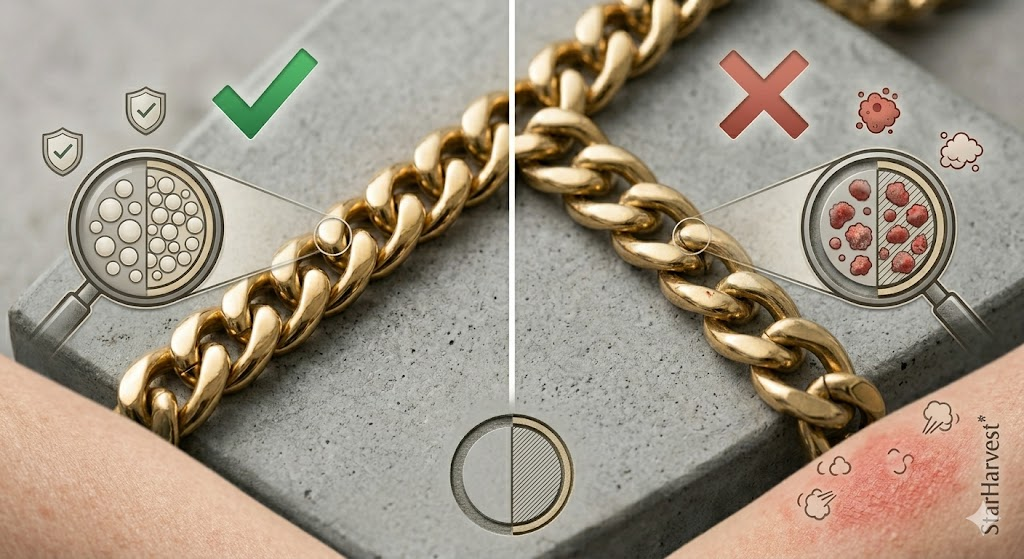
What is Nickel and Why Does It Matter in Jewelry?
Nickel serves as a silvery-white transition metal frequently utilized as a strengthening agent in accessory alloys. It is prioritized in manufacturing for its exceptional mechanical toughness and anti-corrosive properties—foundational traits for product longevity.
Nevertheless, a significant demographic quadrant exhibits acute sensitivity to nickel, which triggers Nickel Allergic Contact Dermatitis (NACD), manifesting as erythema, pruritus, or localized rashes. Statistical data indicates that roughly 15% of women and 2% of men suffer from NACD. The higher prevalence in women is attributed to increased cumulative exposure through fashion accessories from a developmental age. Consequently, brands must prioritize adherence to rigorous nickel release directives. This protocol safeguards consumer health, anchors brand credibility, and mitigates legal liabilities. StarHarvest ensures every engineered component flawlessly exceeds these critical industrial benchmarks.
Does 304 and 316L Stainless Steel Jewelry Contain Nickel?
Affirmative, both 304 and 316L industrial alloys integrate nickel. However, the paramount factor is the migratory volume, not the baseline percentage of nickel within the substrate. Provided the release rate complies with legislative mandates, the jewelry remains biocompatible.
Commercial 304 steel typically integrates 8% to 10.5% nickel, with an estimated release rate hovering beneath 0.3 µg/cm²/week. In contrast, 316L surgical steel—the foundational matrix of our elite stainless steel jewelry production—contains a higher nickel concentration (10% to 14%). Paradoxically, it yields an even lower release rate, consistently beneath 0.1 µg/cm²/week. This superior stability is driven by the infusion of molybdenum, which radically enhances the molecular lattice and suppresses nickel leaching.
Is Stainless Steel Jewelry Truly Nickel-Free?
By strict linguistic definition, the alloy is not devoid of nickel. In commercial reality, however, the material is designated as “nickel-safe” or “nickel-free” if it conquers international safety standards. The European Union Nickel Directive authorizes the “nickel-free” label for assets releasing less than 0.5 µg/cm²/week. Therefore, industrial focus has shifted from content to biocompatible release.
316L surgical steel, for instance, maintains a release profile below 0.1 µg/cm²/week. When addressing inquiries regarding whether 316L steel contains nickel, the technically accurate response is yes, but with a strategic emphasis on its “nickel-safe” status due to its negligible release metrics.
What Jewelry Materials Are Considered Nickel-Free?
The “nickel-free” designation encompasses components that either lack nickel entirely or restrict its release below clinical safety margins. Optimal industrial selections include:
304 Stainless Steel: Integrates nickel, yet release rates are compliant. An economically optimized solution for high-volume fashion accessories.
316L Stainless Steel: Hyper-low release, achieving supreme compliance. The mandatory choice for reactive demographics, body piercing hardware, and a daily-wear stainless steel ring.
925 Sterling Silver: Traditionally nickel-free (provided it is alloyed strictly with copper). Ideal for prestige, heritage-centric collections.
Higher Karat Gold (18K+): Inherently nickel-free. Reserved for luxury-tier, hyper-hypoallergenic premium lines.
Stainless Steel
Are you wondering if surgical-grade steel incorporates nickel? The 316L variant is ubiquitously referenced as surgical steel due to its critical applications in clinical implants. While 304 and 316L both harbor nickel, their release profiles are mathematically insignificant, rendering a stainless steel bracelet perfectly suitable for unhealed piercings and internal medical devices.
Sterling Silver
Authentic 925 silver is synthesized from 92.5% fine silver and 7.5% auxiliary metals, predominantly copper. While sub-standard silver items are occasionally alloyed with nickel, elite-grade sterling silver and our professionally encapsulated brass jewelry configurations are fundamentally nickel-free.
Higher Karat Gold
Addressing the inquiry of whether gold harbors nickel: the answer fluctuates based on the karat weight. 24K pure gold is completely inert and nickel-free. Elevated karat formulations, such as 14K and 18K, maximize pure gold content while diluting the presence of alloyed transition metals, virtually eradicating nickel traces and ensuring a hyper-durable, skin-safe finish.
Nickel Regulations in Jewelry
Two predominant international frameworks dictate nickel release parameters in the modern market:
EU Standards: REACH Nickel Release Limits
The European Union’s Nickel Directive, encapsulated within the Registration, Evaluation, Authorization, and Restriction of Chemicals (REACH) framework, rigorously monitors hazardous elements in consumer goods. It mandates maximum release thresholds of: 0.2 µg/cm²/week for internal piercing hardware and 0.5 µg/cm²/week for standard dermal contact. 304 and 316L alloys routinely conquer these assays, justifying their status as the industry standard for nickel-safe production.
US Standards: California Proposition 65
While the U.S. lacks a federal statutory mandate for nickel release, many elite brands voluntarily adopt EU REACH protocols. However, California’s Proposition 65 classifies nickel as a potential carcinogen, restricting any nickel variant with an aqueous solubility exceeding 0.1 mol/L at 20°C.
316L vs. 304 Stainless Steel–Which Has Lower Nickel and Is Safer for Jewelry?
A technical audit of the performance metrics of industrial alloys reveals that while 304 steel possesses a lower nickel percentage, 316L exhibits superior molecular retention. The molybdenum content within 316L acts as a metallurgical anchor, exponentially bolstering corrosion resistance and minimizing ionic leaching. Consequently, while 304 steel is cost-effective, it may trigger reactions in hyper-sensitive individuals. 316L surgical steel serves as the ultimate nickel-safe foundation, ensuring any heavy stainless steel chain is safe for the most reactive demographics.
Which Jewelry Brands Should Focus on Nickel-Free Jewelry?
Specific product categories demand obsessive focus on nickel release due to prolonged dermal exposure and biological sensitivity. If your enterprise specializes in the following sectors, nickel-free integrity is mandatory:
Children’s Jewelry Brands
Infant epidermis is hyper-permeable, making nickel exposure a severe biological risk. Labels targeting this demographic must exclusively deploy durable, nickel-safe matrices like 316L steel or solid gold to prevent allergic pathogenesis.
Body Piercing Studios
Hardware utilized for fresh punctures must prioritize biological neutrality, as open wounds aggressively absorb environmental elements. Even molecular traces of nickel can incite infections or severe dermal rejection. Utilizing 316L surgical-grade alloys is the only verified protocol for total safety.
Earrings Brands
Piercing hardware is subjected to high-friction dermal contact within the earlobe—a hyper-sensitive zone. Specialized boutiques should exclusively source 316L steel or low-nickel alloys enhanced with our premier gold plating solutions utilizing vacuum PVD technology. These treatments not only mitigate allergic risks but exponentially amplify chromatic retention and reflective luster.
Methods for Identifying Nickel-Free Jewelry
We advise implementing these diagnostic protocols to verify the nickel-safe status of your inventory:
Look for “Nickel-Free” Labels
Begin by scrutinizing technical specifications and metallurgical dossiers provided by the vendor. Prioritize designations such as “316L,” “Surgical Stainless Steel,” or “Nickel-Safe.” However, as labeling mandates vary geographically, the most robust protocol is verifying the actual atomic composition through certified lab reports.
Check for Nickel Release Lab Test Results
This clinical procedure quantifies the volume of nickel leaching from the hardware into a simulation solution, mimicking human biological interaction. At StarHarvest, our draconian Quality Control (QC) involve mandatory nickel release assays and 100% compliance with REACH directives, supported by ISO/SGS certifications to validate authenticity and sustain our aggressive 99% production yield.
Does Nickel-Free Jewelry Mean Hypoallergenic?
“Nickel-free” and “Hypoallergenic” are not interchangeable terms. A “nickel-free” designation confirms that the hardware adheres to the specific release thresholds mandated for dermal sensitivity.
“Hypoallergenic,” conversely, indicates a significantly reduced probability of triggering any adverse biological reaction. This does not automatically imply a total absence of nickel. Addressing the query: Is steel jewelry hypoallergenic? Affirmative; elite grades like 304 and 316L are definitively hypoallergenic because their nickel release metrics are mathematically negligible, rendering a stainless steel necklace exceptionally safe for perpetual wear.
Will Nickel-Free Jewelry Tarnish?
Affirmative; certain nickel-safe substrates are susceptible to tarnishing. It is critical to recognize that oxidation has zero correlation with nickel content. Instead, tarnishing is driven by the utilization of reactive base metals like brass or copper when subjected to environmental moisture or sulfur. For brands searching for tarnish-proof assets, PVD-enhanced steel and high-karat gold represent the apex manufacturing solutions. Raw sterling silver remains high-quality, yet will naturally oxidize absent professional plating.
Will Nickel-Free Jewelry Turn Green?
Negative; authentically nickel-safe accessories rarely induce epidermal greening because they omit reactive cupric bases. Discoloration is exclusively triggered by copper or low-grade brass oxidation. High-integrity materials—such as medical steel, pure silver, and gold—sustain their chromatic perfection, ensuring total comfort for sensitive demographics.
Conclusion
Nickel represents a profound threat to demographics with dermal sensitivities; however, by specifying 304 or 316L surgical-grade alloys, your brand secures total immunity from allergic reactions. These matrices are industrially validated as nickel-safe and serve as the ideal foundational substrate for labels dominating the sensitive-skin market.
Forge a strategic alliance with a world-class custom manufacturer like StarHarvest—leveraging our 20-year legacy of technical mastery—to procure premium, compliant collections engineered for even the most reactive end-consumers.
FAQs
1. Is nickel in stainless steel harmful?
Nickel within high-grade steel is fundamentally non-toxic. In elite matrices like 316L, the nickel is molecularly locked, with release rates plummeting far below safety thresholds, rendering it perfectly safe for global distribution.
2. Is surgical steel nickel free?
Strictly speaking, 316L surgical steel integrates nickel, but it is effectively “nickel-safe” due to its near-zero release metrics, meeting all clinical standards for medical implantation and sensitive accessory wear.
3. Is stainless steel suitable for sensitive skin?
Emphatically yes. 316L surgical steel is the gold standard for reactive skin. Its profound resistance to corrosion and ultra-low nickel release minimizes the risk of inflammation, making it the safest medium for unhealed piercings and perpetual daily wear.

