
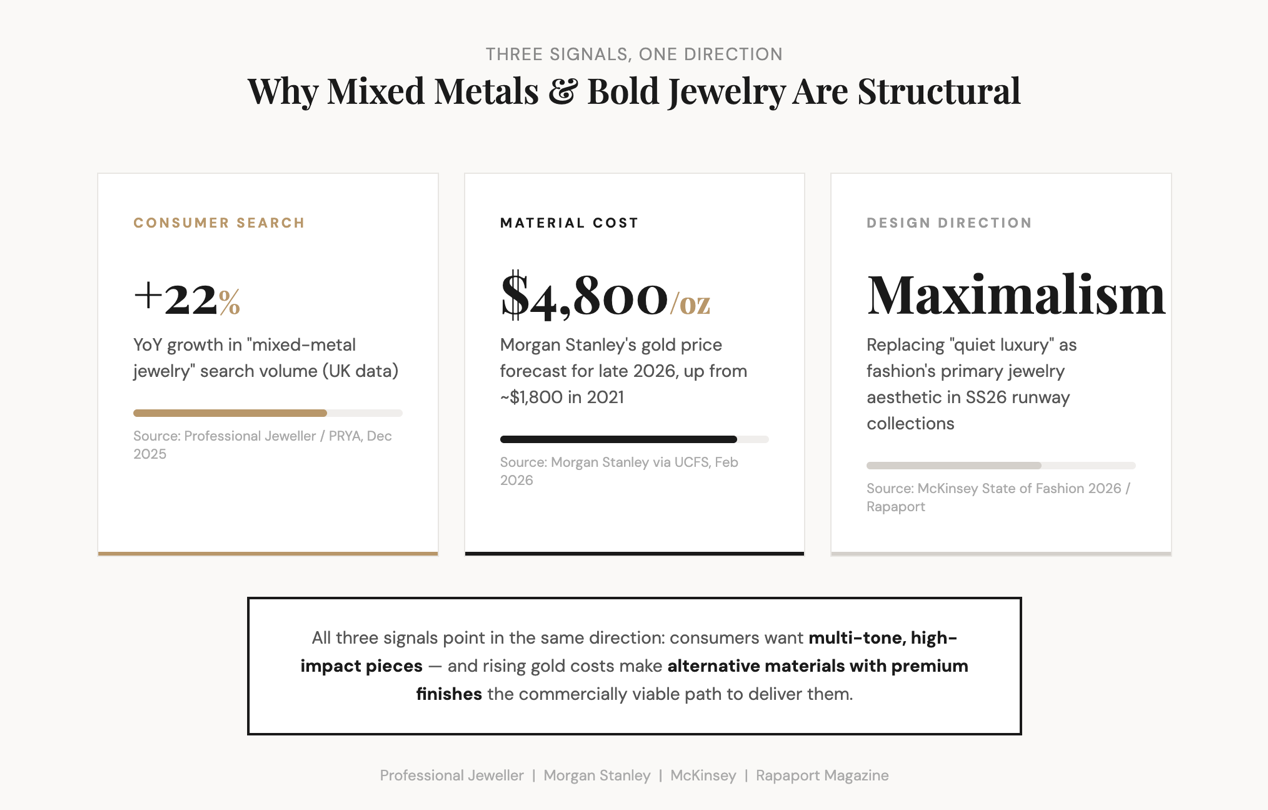
Mixed metal jewelry is no longer a styling experiment — it is a measurable commercial shift. UK search data from Professional Jeweller shows mixed-metal jewelry queries grew 22% year-over-year, with mixed-metal stacking rings leading the surge as consumers move away from single-tone purchasing habits.¹ McKinsey’s State of Fashion 2026 confirms the broader pattern: jewelry design is shifting from quiet luxury toward expressive, personal, and intentional aesthetics.²
Most coverage of this trend focuses on what consumers should buy. This article takes a different angle — how fashion jewelry brands can translate the mixed-metal and bold jewelry movement into manufacturable, scalable product lines. The gap between a runway concept and a production-ready SKU is where most brands lose momentum.
Why Mixed Metals and Bold Jewelry Are More Than a Passing Trend
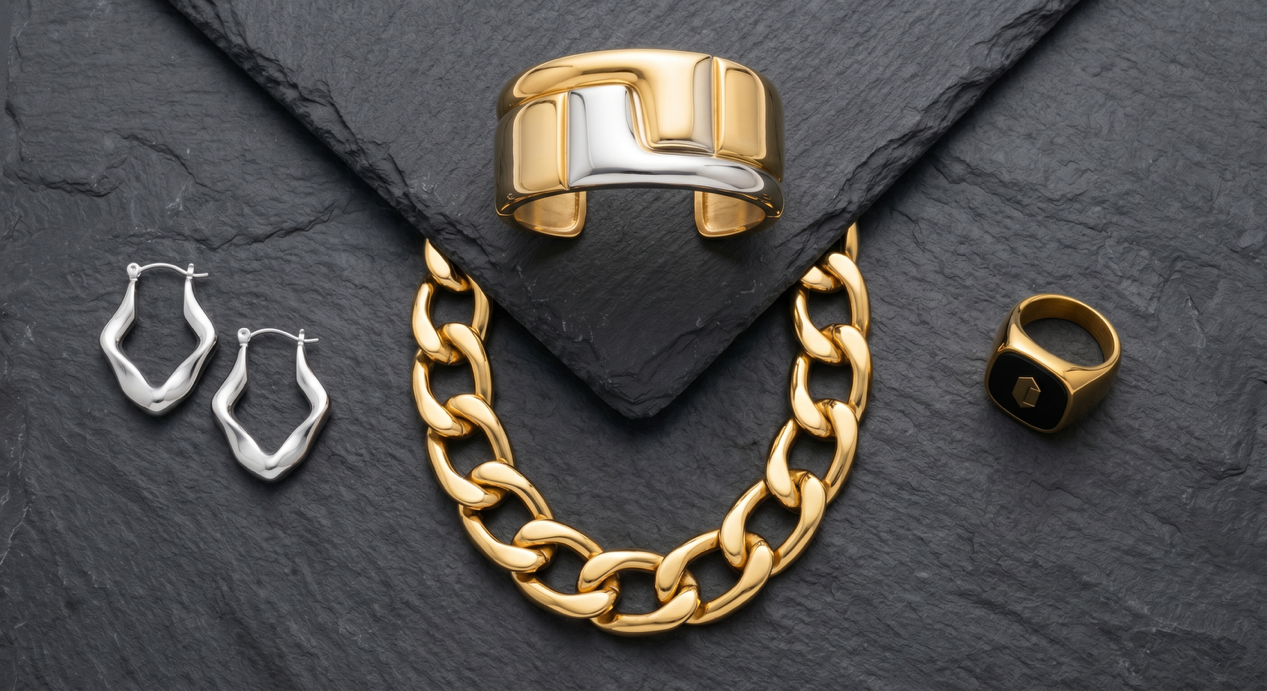
The return of maximalism in jewelry is structural, not cyclical. Rapaport’s 2026 market analysis reports that consumers are choosing fewer, higher-impact pieces rather than accumulating understated styles.³ Bold statement jewelry — oversized cuffs, chunky link chains, sculptural earrings — is no longer reserved for special occasions. Buyers are integrating these pieces into daily wear as part of their personal identity.³
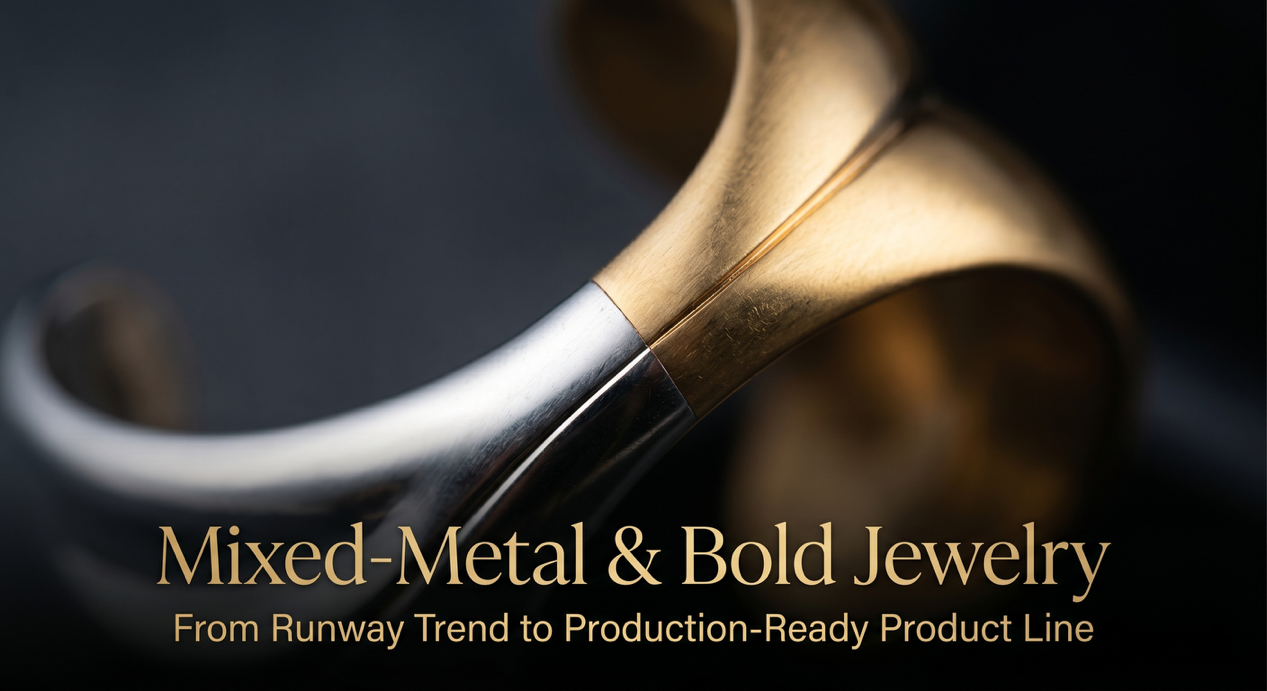
The mixed-metal dimension adds a second layer. Jewelers Mutual’s 2026 trend forecast notes that designers are now blending metals within single pieces — platinum shanks with yellow gold bezels, modular components that interchange across tonal finishes — rather than simply mixing separate gold and silver items.⁴ This in-piece mixing represents a fundamental design shift with direct manufacturing implications.
Two macro forces are accelerating adoption. First, gold prices: Morgan Stanley forecasts gold could reach $4,800 per ounce by late 2026, pushing both designers and consumers toward multi-tone combinations that use less pure gold per piece.⁵ Second, social media aesthetics: the “curated chaos” styling popularized on TikTok and Instagram rewards visual contrast and tonal depth over monochrome uniformity.
Fashionista describes the 2026 jewelry moment as “intentional maximalism” — bold, expressive, and personal rather than simply accumulated.⁶ Jillian Sassone, founder of Marrow Fine Jewelry, summarizes the consumer mindset directly: people want pieces that feel collected, expressive, and a little unexpected.⁶
The Manufacturing Challenge Brands Overlook
Designing a mixed-metal collection is straightforward. Producing it at consistent quality and manageable cost is not. Three specific manufacturing challenges separate trend-responsive brands from those that stall at the concept stage.
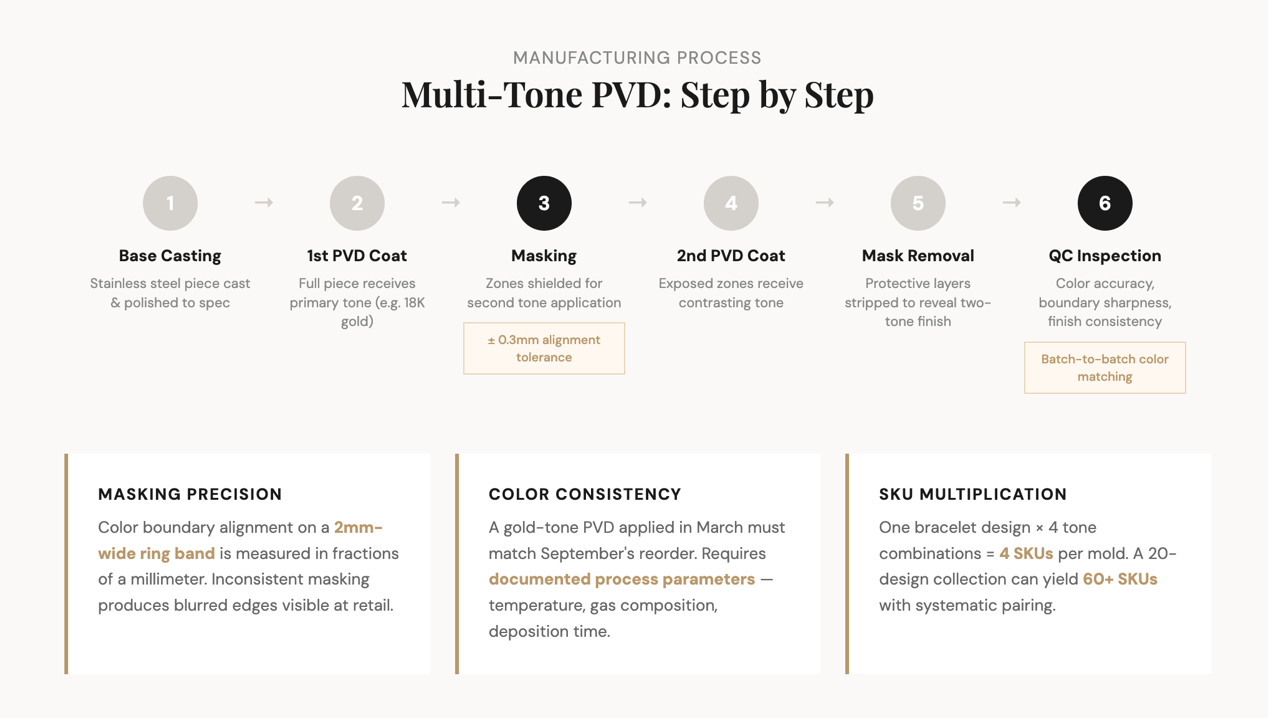
Multi-tone surface finishing. Achieving two or more PVD (Physical Vapor Deposition) tones on a single stainless steel piece requires precise masking — physically shielding designated zones during the coating process so each area receives only its intended color. The tolerance for masking alignment on a 2mm-wide ring band, for example, is measured in fractions of a millimeter. Inconsistent masking produces blurred color boundaries that are immediately visible at retail.
Batch-to-batch color consistency is a separate challenge. A gold-tone PVD applied in March must match the same gold tone applied in September when a retailer reorders. This requires documented process parameters (temperature, gas composition, deposition time) and systematic quality control across production runs.
Bold and sculptural form factors. Statement jewelry trends in 2026 — chunky cuffs, oversized link chains, sculptural earrings — introduce structural engineering requirements that minimalist designs do not. Wall thickness must be sufficient for durability without making the piece uncomfortably heavy. A 40mm-wide stainless steel cuff, for instance, needs to balance rigidity (to hold its shape on the wrist) against weight (to remain wearable for a full day).
Casting complexity also increases. Organic, flowing silhouettes with irregular curves and hollow sections require more sophisticated mold design and tighter quality inspection than flat or geometric forms.
SKU multiplication. Mixed-metal jewelry inherently multiplies the number of SKUs per design. A single bracelet that previously shipped in gold tone only might now require gold/silver, gold/rose gold, silver/rose gold, and tri-tone versions. Each combination needs its own sampling, quality verification, and inventory management. Brands that do not account for this multiplication at the planning stage face either supply chain bottlenecks or uncontrolled SKU sprawl.
How Fashion Jewelry Brands Can Execute This Trend at Scale
The manufacturing challenges above are solvable. They require specific processes and a supplier partnership structured around multi-tone production — not a general-purpose jewelry manufacturer retrofitting for a trend.
PVD as the primary enabler for mixed metals. PVD coating on stainless steel is the most commercially viable path to multi-tone jewelry at scale. A single stainless steel base piece can receive gold, rose gold, silver (rhodium-tone), and black PVD finishes through sequential masking and coating cycles. The base material remains consistent; only the surface treatment changes. This means the same casting, the same structural properties, and the same base cost — with color variation handled entirely at the finishing stage.
For brands, this translates to a specific product development advantage: one mold investment serves multiple colorway SKUs. The per-unit cost increase for a two-tone finish versus a single-tone finish is primarily in masking labor and an additional PVD cycle — meaningful, but far less than designing and tooling a separate product.
Two-tone electroplating for brass. Brass jewelry offers a different execution path. Selective electroplating — applying gold-tone plating to certain zones while leaving others in rhodium or a contrasting finish — achieves the mixed-metal look through chemical processes rather than PVD. This approach suits designs where softer forms and warmer base tones are part of the aesthetic intent.
The trade-off is durability. Electroplated finishes on brass typically have a shorter wear lifespan than PVD on stainless steel. Brands targeting the $100–$250 range with seasonal refresh cycles may find this acceptable. Those positioning at $250+ with a “buy fewer, keep longer” message should lean toward PVD on stainless steel.
From “one design, one color” to modular tone systems. The most efficient approach to mixed-metal product planning is not designing individual two-tone pieces ad hoc, but building a modular tone system. Define three or four base tones (e.g., 18K gold PVD, rose gold PVD, steel/silver, matte black) and engineer every new design to accept any two-tone combination from that palette.
This requires upfront investment in masking templates and color standards, but it dramatically reduces the per-SKU cost of adding new combinations later. A 20-design collection with four tone options and systematic two-tone pairing can yield 60+ SKUs from a manageable production setup.
Validate at the sampling stage. Multi-tone combinations that look compelling in a CAD rendering do not always translate to physical product. Color contrast that reads well on screen may appear muddy at small scale, or a masking line that looks clean on a flat surface may wobble across a curved contour. Brands should request physical samples of every planned tone combination and evaluate them under both studio lighting and natural light before committing to production.
How Star Harvest Supports Mixed-Metal Production
Star Harvest’s manufacturing infrastructure is built around the specific processes this trend demands. Multi-tone PVD coating with documented masking protocols and batch-tracked color parameters allows brands to reorder with confidence that September’s rose gold matches March’s. Stainless steel casting capabilities accommodate the wall-thickness and weight requirements of bold, sculptural forms without sacrificing wearability.
For brands entering the mixed-metal category, Star Harvest supports the full development path: from initial design consultation on tone-combination feasibility, through multi-tone sample production, to scaled manufacturing with consistent quality across SKUs and reorders. The goal is to close the gap between a trend that consumers want and a product line that a brand can reliably deliver.
References
- “Mixed Metal Is Set to Define 2026 Jewellery Trends.” Professional Jeweller, Dec. 2025.
- McKinsey & Company and The Business of Fashion. The State of Fashion 2026.McKinsey & Company, 2025.
- “Five Trends Dominating the 2026 Jewelry Market.” Rapaport Magazine, Mar. 2026.
- “2026 Jewelry Trends Forecast: What’s Ahead in Style and Design.” Jewelers Mutual Group, Dec. 2025.
- “5 Trends Shaping the Jewelry Industry and Market Outlook in 2026.” United Consumer Financial Services (UCFS), Feb. 2026.
- Maguire, Tyler. “A New Era of Maximalist Jewelry Is Upon Us.” Fashionista, Feb. 2026.

