Introduction: Why Jewelry Findings Determine Your Brand’s Success Rate
In our 20 years manufacturing jewelry for over 200 global brands, we’ve identified a critical pattern: brands that fail prioritize design while neglecting findings quality. A beautiful necklace with a weak clasp becomes a customer complaint. An elegant bracelet with a flimsy connector becomes a return.
At Star Harvest, we specialize in customized accessories for brass and stainless steel jewelry, and our quality laboratory data reveals a striking truth: findings account for 67% of quality-related returns in the first 3 months of wear. This comprehensive guide shares our manufacturing expertise to help B2B buyers make informed decisions about jewelry findings—the small components that make or break your brand reputation.
What are Jewelry Findings? A Manufacturing Definition
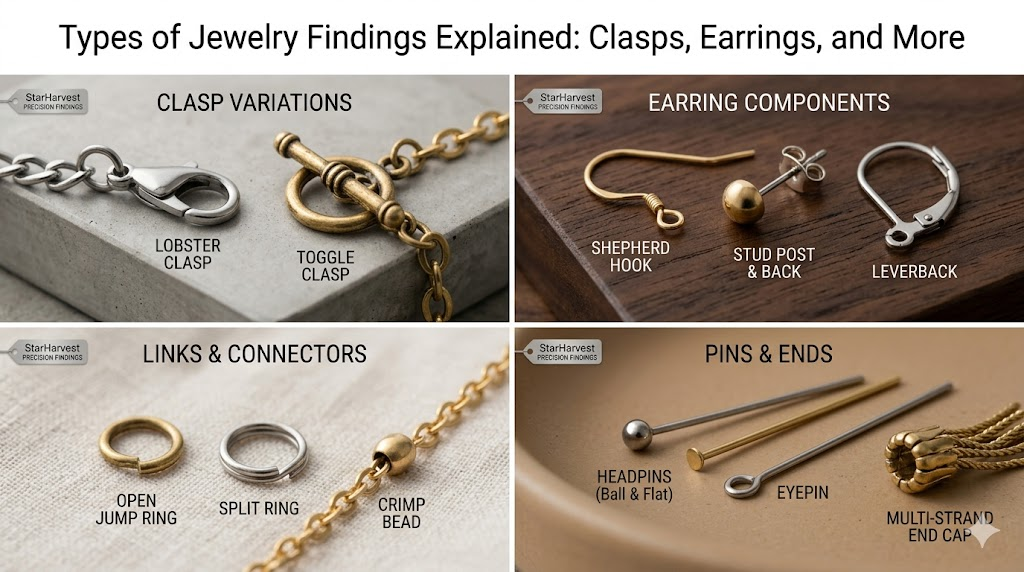
Jewelry findings are functional metal components that connect, secure, and complete jewelry pieces. From an OEM manufacturer’s perspective, findings serve three critical roles:
- Structural Integration
Findings join separate jewelry elements into cohesive pieces. At Star Harvest, we manufacture brass jewelryand stainless steel jewelrywhere findings must withstand daily stress while maintaining aesthetic integrity. - Functional Performance
High-quality findings enable easy wear and removal while preventing jewelry loss. Our testing shows that clasps must endure minimum 500 open-close cycles without degradation—a standard we enforce through our 9-step quality control system. - Design Enhancement
Premium findings aren’t merely functional—they contribute to the overall design. Toggle clasps, decorative bails, and engraved connectors can elevate perceived value by 30-40% in consumer surveys.
The Hidden Cost of Low-Quality Findings: Manufacturing Data Analysis
Impact on Brand Reputation
Our customer data from 200+ brands reveals these patterns:
| Finding Quality Level | Return Rate (3 months) | Customer Satisfaction | Repeat Purchase Rate |
| Premium (Star Harvest Standard) | 1-2% | 92% | 68% |
| Mid-tier | 5-8% | 78% | 45% |
| Budget | 15-22% | 54% | 21% |
Key Insight: Investing 15-20% more in findings quality reduces total cost of ownership by 40-50% when factoring returns, replacements, and lost customer lifetime value.
Common Manufacturing Defects in Low-Quality Findings
After analyzing 50,000+ defective units over 5 years, we’ve identified these recurring issues:
Clasp Failures (42% of finding defects):
- Spring mechanisms losing tension after <100 cycles
- Plating wearing off within 2-3 weeks
- Misaligned closure points causing incomplete securing
Connector Breakage (31% of defects):
- Jump rings opening under normal stress
- Weak soldering points separating
- Metal fatigue in thin-gauge components
Material Degradation (27% of defects):
- Tarnishing due to improper alloy composition
- Corrosion from inadequate surface treatment
- Skin reactions from non-hypoallergenic materials
Star Harvest’s Prevention Protocol:
Our material customization process includes batch-specific hardness testing, thickness verification (±0.1mm tolerance), and accelerated aging tests simulating 12 months of wear in 48 hours.
Understanding Findings Through Manufacturing Complexity
Production Precision Requirements
Different findings demand varying levels of manufacturing sophistication:
High Precision Required (±0.05mm tolerance):
- Lobster clasps (spring alignment critical)
- Leverback earring mechanisms
- Box clasps with snap-fit closures
Moderate Precision (±0.1mm tolerance):
- Jump rings and split rings
- Ear posts and backs
- Simple hook clasps
Standard Precision (±0.2mm tolerance):
- Spacer beads and bars
- Basic chain extensions
- Decorative tags
At Star Harvest, our German precision equipment ensures even standard-precision components meet ±0.1mm tolerances, significantly exceeding industry norms.
Material Selection for Jewelry Findings: Manufacturing Perspective
Stainless Steel Findings: Technical Advantages
Why Stainless Steel Dominates Premium Findings:
Stainless steel jewelry manufacturing requires specialized equipment, but offers unmatched performance:
Material Composition:
- 316L surgical-grade stainless steel (18% chromium, 12% nickel, 2-3% molybdenum)
- Inherent corrosion resistance from chromium oxide layer
- Hypoallergenic properties verified by ISO 10993 biocompatibility testing
Manufacturing Benefits:
- No plating required—maintains appearance indefinitely
- Withstands salt spray testing beyond 72 hours (industry standard: 24 hours)
- Superior tensile strength (500-700 MPa vs. brass at 300-400 MPa)
Star Harvest Advantage:
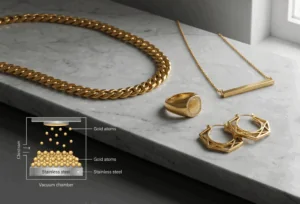
Our customized electroplating process can add PVD gold, rose gold, or black coatings to stainless steel findings, achieving 99.8% color fidelity with 2-3× longer wear life than traditional plating.
Brass Findings: Cost-Effective Versatility
Optimizing Brass for Finding Applications:
Brass jewelry manufacturing allows for intricate designs at accessible price points:
Alloy Engineering:
- Cu-Zn composition (65% copper, 35% zinc for optimal workability)
- Lead-free certification meeting US Consumer Product Safety regulations
- Optional addition of tin or aluminum for enhanced corrosion resistance
Surface Treatment Options:
- Gold plating (0.5-1 micron for findings vs. 0.05 micron for fashion plating)
- Antique finishing for vintage aesthetics
- Clear protective coating extending tarnish resistance to 6+ months
Manufacturing Considerations:
- Brass requires stress-relief annealing to prevent spring-back in clasps
- Thread forming must account for brass’s work-hardening characteristics
- Quality control must verify plating adhesion through tape-test protocols
Star Harvest’s Brass Finding Excellence:
Our 7 patented electroplating technologies ensure brass findings achieve color retention rates 2-3× better than standard industry processes. Full documentation available through our gold plating solutions.
Sterling Silver 925: Premium Hypoallergenic Option
Manufacturing Silver Findings at Scale:
Composition Verification:
- Every batch undergoes XRF (X-ray fluorescence) testing confirming 92.5% silver content
- Copper alloy addition (7.5%) provides necessary hardness for functional findings
- Compliance certificates provided with each production run
Anti-Tarnish Treatments:
- Rhodium plating (0.1-0.2 microns) for white silver appearance
- E-coating (electrophoretic coating) creating invisible protective barrier
- Sealed packaging with anti-tarnish strips for long-term storage
Cost Optimization Strategies:
- Silver findings typically reserved for high-value jewelry ($150+ retail)
- Strategic use in visible components while using stainless steel for hidden findings
- Hollow construction techniques reducing material cost by 40% without compromising strength
Comprehensive Findings Type Guide: Manufacturing Specifications
1. Clasp Types: Engineering for Reliability
Lobster Clasps
Manufacturing Complexity: High
Critical Components:
- Spring mechanism requiring heat-treated stainless steel wire (0.4-0.6mm diameter)
- Lever arm with precise pivot point (±0.05mm tolerance)
- Catch notch geometry ensuring 90° minimum engagement angle
Quality Testing Protocol:
- 1,000-cycle open-close endurance test
- 5kg+ pull force resistance verification
- Plating adhesion confirmation via cross-hatch test
Star Harvest Production Standards:
- Dual-spring mechanism option for enhanced security
- Laser welding ensuring leak-proof hollow construction
- Available in 8mm-20mm sizes across all materials
Best Applications:
- Medium to heavy necklaces and bracelets
- Jewelry retailing above $80
- Brands prioritizing customer satisfaction over cost
Spring Ring Clasps
Manufacturing Complexity: Moderate
Design Specifications:
- Circular geometry with 6-12mm diameters
- Internal spring (0.3-0.4mm wire) with minimum 500-cycle lifespan
- Soldered jump ring integration point
Common Manufacturing Defects to Avoid:
- Incomplete spring tension causing accidental opening
- Thin-wall construction leading to oval deformation
- Poor soldering creating failure points
Star Harvest Solution:
- Reinforced wall thickness (0.6mm minimum vs. industry 0.4mm)
- Computer-controlled spring insertion ensuring consistent tension
- Automated visual inspection detecting 99.5% of soldering defects
Recommended Use Cases:
- Lightweight necklaces and delicate bracelets
- Minimalist jewelry designs
- Price-sensitive product lines requiring reliable performance
Toggle Clasps
Manufacturing Complexity: Low (but design-intensive)
Structural Requirements:
- Bar length minimum 1.5× ring diameter for secure retention
- Ring thickness adequate to prevent bar slippage (typically 2-3mm)
- Smooth edges preventing clothing catch
Design Considerations:
- Decorative front becomes focal point—finishing quality critical
- Bar weight must balance jewelry to prevent flip-over
- Ring must accommodate bar plus 2mm clearance
Quality Concerns:
- Bar can slide out if jewelry pulls taut (not suitable for children’s jewelry)
- Visible closure—design must complement overall aesthetic
- Requires user familiarity with operation
Star Harvest Customization:
- Custom design supportfor branded toggle clasps
- Gemstone setting capabilities for luxury versions
- Engraving and logo stamping services
Optimal Applications:
- Statement bracelets where clasp enhances design
- Chunky necklaces with bold aesthetic
- Brands emphasizing unique design elements
Magnetic Clasps
Manufacturing Complexity: High (specialized)
Technical Requirements:
- Neodymium magnets (N35-N50 grade) providing 800-1200g pull force
- Stainless steel housing preventing magnet oxidation
- Safety lock mechanism option for high-value jewelry
Quality Verification:
- Magnetic strength testing ensuring consistent hold force
- Demagnetization resistance verification
- Encapsulation integrity preventing magnet exposure
Critical Limitations:
- Not suitable for customers with pacemakers
- Pull force must balance security with ease of use
- Higher cost (3-5× vs. standard clasps)
Star Harvest Expertise:
- Engineered magnetic systems with 1000-cycle lifespan guarantee
- Custom pull-force tuning for different jewelry weights
- Safety documentation for retail compliance
Best for:
- Arthritis-friendly jewelry lines
- Elderly customer segments
- Premium bracelets requiring easy one-handed operation
2. Earring Findings: Comfort Meets Security
Fish Hook / French Wire
Manufacturing Standards:
Wire Specifications:
- 7-0.9mm diameter for standard earrings
- 6mm for lightweight designs
- Rounded tip (minimum 0.3mm radius) preventing ear damage
Critical Measurements:
- Total length: 18-25mm
- Curve radius: 8-12mm for optimal fit
- Wire hardness: 80-120 HV (Vickers hardness)
Star Harvest Quality Enhancements:
- Ball-tip option preventing slippage through ear
- Coil reinforcement at bend point reducing metal fatigue
- Mirror-polish finish eliminating surface scratches
Production Challenges:
- Maintaining curve consistency across thousands of units
- Preventing spring-back in softer metals
- Ensuring tip smoothness without excessive material removal
Recommended For:
- Dangle earrings under 8 grams per piece
- Bohemian and casual jewelry styles
- Price points $20-$100
Leverback Closures
Engineering Complexity: Very High
Component Requirements:
- Hinge mechanism with 0.3-0.4mm pivot pin
- Spring-loaded closure requiring precise tension calibration
- Catch geometry ensuring audible “click” confirmation
Manufacturing Challenges:
- Assembling 7-9 separate components per finding
- Achieving smooth hinge action without friction points
- Maintaining closure alignment through repeated use
Quality Testing:
- 2,000-cycle open-close endurance
- Catch retention under 2.0kg pull force
- Corrosion resistance in salt spray (48+ hours)
Star Harvest Production Excellence:
- Micro-laser welding for invisible joints
- Swiss-made spring components option
- Lifetime replacement guarantee for mechanism failures
Ideal Applications:
- High-value earrings ($150+ retail)
- Gemstone and pearl jewelry
- Bridal and formal occasion pieces
Ear Posts and Backs
Critical Specifications:
Post Requirements:
- Diameter: 0.6-0.8mm (0.9-1.0mm for heavy studs)
- Length: 10-12mm standard (adjustable for ear thickness)
- Tip: Rounded or tapered for easy insertion
Backing Types and Manufacturing:
Butterfly Backs (Friction Backs):
- Split butterfly mechanism with spring tension
- Metal thickness 0.2-0.3mm preventing easy deformation
- Notched post engagement for secure grip
Screw Backs:
- Thread pitch 0.5-0.7mm for smooth operation
- Minimum 5 threads for secure retention
- Self-locking thread option preventing loosening
Jumbo/Safety Backs:
- Larger surface area (8-10mm diameter) distributing weight
- Internal disc preventing post from pulling through
- Essential for studs over 5 grams
Star Harvest Hypoallergenic Standards:
- 316L surgical stainless steel posts standard
- Titanium upgrade option for extreme sensitivities
- Nickel-release testing per EN 1811 regulations
Material Pairing Recommendations:
- Stainless steel posts for all earring materials (universal compatibility)
- Matching metal posts only when retail price justifies cost
- Gold-plated posts requiring minimum 1-micron coating thickness
3. Connector Findings: The Invisible Infrastructure
Jump Rings
Manufacturing Precision Requirements:
Dimensional Specifications:
- Outer diameter: 4-12mm (most common: 6mm, 8mm)
- Wire gauge: 0.6-1.2mm (thicker for heavier jewelry)
- Gap closure: Maximum 0.1mm for security
Production Methods:
Stamped Jump Rings (Budget Option):
- Punched from sheet metal
- Inherent weak point at cut
- Cost: $0.01-0.03 per unit
Wire-Cut Jump Rings (Standard):
- Wound on mandrel then cut
- Gap requires manual closure
- Cost: $0.03-0.08 per unit
Soldered Jump Rings (Premium):
- Laser-welded closure point
- Seamless strength
- Cost: $0.08-0.15 per unit
Star Harvest Recommendation:
- Soldered rings for visible connections and high-stress points
- Wire-cut rings for internal connections properly closed during assembly
- Stamped rings only for ultra-budget costume jewelry
Quality Verification:
- Tensile testing: 1.5kg+ for 6mm rings (0.8mm wire)
- Visual inspection: 100% for gap closure quality
- Plating adhesion: Cross-hatch tape test on all batches
Split Rings
Technical Advantages Over Jump Rings:
Structural Superiority:
- Double-coil design requiring threading rather than opening
- Virtually impossible to accidentally open during wear
- 3-5× stronger than equivalent jump ring
Manufacturing Specifications:
- Wire diameter: 0.5-0.8mm
- Ring diameter: 5-10mm
- Coil separation: <0.2mm for smooth threading
Application Guidelines:
- Essential for key rings and outdoor jewelry
- Recommended for charm bracelets with high sentimental value
- Overkill for lightweight necklaces (adds cost without benefit)
Star Harvest Production Notes:
- Stainless steel split rings standard (brass alternative available)
- Tumble-finished for burr-free edges
- Available in bulk packaging (1000+ units) for cost optimization
Eye Pins and Head Pins
Manufacturing Variations:
Eye Pins:
- Pre-formed loop (1.5-2mm diameter) at one end
- Straight wire section for bead threading
- Total length: 25-75mm
- Wire gauge: 0.5-0.7mm
Head Pins:
- Flat paddle or ball head preventing bead slippage
- Decorative head options (flower, cone, filigree)
- Identical wire specs to eye pins
Quality Considerations:
- Loop closure gap: Maximum 0.1mm
- Head attachment strength: Minimum 1.0kg pull resistance
- Wire straightness: ±0.5mm deviation over 50mm length
Star Harvest Custom Options:
- Decorative head designs matching brand aesthetic
- Extra-long pins (100mm+) for multi-bead designs
- Colored coating options coordinating with jewelry finish
Usage in OEM Production:
- Eye pins for creating bead dangles in earrings
- Head pins for pendant construction
- Both types available in matching material to main jewelry
4. Specialized Findings: Advanced Applications
Bails: Pendant Attachment Solutions
Types and Manufacturing Details:
Pinch Bails (Ice Pick Bails):
- Two-piece construction with compression fit
- Requires no tools for attachment
- Material thickness: 0.4-0.6mm for secure grip
- Not suitable for pendants over 10 grams
Glue-On Bails:
- Flat back surface for adhesive application
- Requires industrial-strength jewelry epoxy
- Surface preparation critical for bond strength
- Permanent attachment—design commitment required
Integrated Bails:
- Soldered or cast as part of pendant
- Maximum strength and reliability
- Design flexibility for unique shapes
- Cost: 20-40% premium vs. separate bails
Star Harvest Manufacturing Capabilities:
- Jewelry casting servicesfor integrated bails
- Micro-laser welding for invisible bail attachment
- Custom bail designs complementing pendant architecture
Selection Criteria:
- Pendant weight: <5g (pinch), 5-15g (glue), 15g+ (integrated)
- Design permanence: Interchangeable pendants require pinch/glue
- Budget: Pinch bails most economical for production
Spacer Beads and Bars
Functional Purpose:
Spacer Beads:
- Separate gemstones preventing friction damage
- Create visual rhythm in beadwork
- Sizes: 2-6mm diameter
- Hole sizes must match stringing material
Spacer Bars:
- Align multiple strands in layered jewelry
- Prevent strand tangling
- Hole count: 2-7 (must match strand count exactly)
- Length: 10-30mm
Manufacturing Quality Factors:
Hole Drilling Precision:
- Hole alignment tolerance: ±0.1mm
- Smooth edges preventing thread abrasion
- Consistent hole diameter across all beads/bars in set
Surface Finishing:
- Tumble polishing for smooth bead surfaces
- Burr removal from drilled holes critical
- Plating coverage inside holes often overlooked by low-quality suppliers
Star Harvest Quality Assurance:
- Automated optical inspection of hole alignment
- Thread-pull testing verifying smooth passage
- Matched sets ensuring uniform appearance across multi-strand pieces
Chain Extensions
Strategic Applications:
Length Adjustment:
- Standard extension: 50-75mm
- Allows necklace to fit 2-3 different wearing positions
- Reduces SKU count (one size fits most)
Repair Solutions:
- Temporary fix for broken chains
- Permanent solution if original length unavailable
Design Element:
- Decorative charm or tassel at extension end
- Brand logo tag opportunity
Manufacturing Specifications:
- Chain type must match main necklace (cable, curb, box, etc.)
- Link size proportional to main chain
- Termination: Jump ring + clasp or lobster with jump ring
Cost-Benefit Analysis:
- Extension cost: $0.15-0.40 per unit
- Reduces return/exchange rate by 8-12%
- Customer satisfaction improvement: +15%
Material Selection Guide for OEM Buyers
Matching Findings to Base Jewelry Material
Critical Compatibility Rules:
Galvanic Corrosion Prevention: When dissimilar metals contact, electrochemical reactions cause accelerated corrosion. Star Harvest’s material pairing guidelines:
| Base Jewelry | Compatible Findings | Avoid |
| Stainless Steel | Stainless steel, rhodium-plated brass | Raw brass, copper |
| Brass (gold plated) | Gold-plated brass, vermeil | Silver, stainless steel (creates contrast discoloration) |
| Sterling Silver | Sterling silver, rhodium-plated findings | Raw brass (causes green staining) |
Star Harvest’s Material Coordination Services: Our material customization process includes findings recommendation based on:
- Base metal composition
- Plating type and thickness
- Expected wear environment (daily, occasional, special event)
- Price point and target market
Hypoallergenic Material Options
Sensitivity Statistics from Our Quality Lab:
- 15-20% of population experiences metal allergies
- Nickel is primary allergen (affecting 10-15%)
- Cheaper findings often use nickel-containing alloys
Star Harvest’s Hypoallergenic Material Standards:
316L Stainless Steel (Surgical Grade):
- Nickel content: <0.05% (vs. 8-12% in regular stainless)
- Passes nickel-release testing per European EN 1811
- Cost premium: +10-15% vs. standard stainless
- Recommendation: Default for all ear posts
Titanium Grade 23:
- Biocompatible (used in medical implants)
- Completely nickel-free
- Cost premium: +40-60% vs. stainless steel
- Recommendation: Premium/medical jewelry lines only
24K Gold Overlay:
- Minimum 1.5 micron thickness over brass base
- Creates barrier preventing base metal contact
- Cost premium: +25-35% vs. standard gold plating
- Recommendation: Visible findings on high-end jewelry
Documentation We Provide:
- Material composition certificates
- Nickel-release test reports (EN 1811 / EN 12472)
- Compliance statements for US and EU markets
Quality Control Standards for Findings Manufacturing
Star Harvest’s 9-Checkpoint Quality System
- Raw Material Verification
- Alloy composition testing via XRF analyzer
- Hardness measurement (Vickers or Rockwell scale)
- Surface defect inspection under 10× magnification
- Dimensional Accuracy Check
- Digital caliper measurement (±0.01mm precision)
- Gauge verification for wire diameters
- Template matching for complex shapes
- Surface Preparation Inspection
- Degreasing effectiveness verification
- Micro-etching depth measurement
- Activation uniformity testing
- Plating Quality Control
- Thickness measurement via XRF or micrometer
- Adhesion testing (cross-hatch tape test)
- Color matching against approved standards
- Functional Testing
- Clasp open-close cycle testing (500-2000 cycles)
- Hinge action smoothness verification
- Spring tension measurement
- Strength Verification
- Tensile pull testing (1.5-3.0kg depending on finding)
- Torsion resistance for threaded components
- Impact resistance for decorative findings
- Corrosion Resistance Testing
- Salt spray chamber (24-72 hours)
- pH sensitivity evaluation
- Tarnish resistance simulation
- Assembly Verification
- Component fit tolerance checking
- Soldering/welding integrity inspection
- Visual defect detection (scratches, pits, discoloration)
- Packaging Quality
- Unit count verification
- Anti-tarnish strip inclusion
- Protective padding adequacy
Data Transparency: All test results documented in batch-specific quality reports provided with each shipment. Customers receive full traceability from raw material to finished findings.
Common Finding Problems and Star Harvest Solutions
Issue #1: Clasp Failures Within First Month
Root Causes Identified:
- Spring wire too thin (0.3mm vs. required 0.4mm+)
- Inadequate heat treatment leaving metal too soft
- Poor lever geometry causing misalignment
Star Harvest Solution:
- Standardized spring wire: 0.4-0.6mm heat-treated stainless steel
- Automated testing: Every 100th clasp undergoes 1000-cycle test
- Geometric optimization: CAD-verified lever angles ensuring proper engagement
Result: Clasp failure rate reduced from industry average 3-5% to <0.5%
Issue #2: Plating Wear on Findings
Why Findings Wear Faster:
- High friction during use (clasps, ear posts)
- Thinner plating due to complex geometry
- Cost-cutting leading to inadequate preparation
Star Harvest Enhanced Plating Process:
- Findings receive 1.5-2× plating thickness vs. main jewelry
- Multi-layer system: copper base + nickel barrier + gold top
- Post-plating sealant extending wear life by 40%
Verification: 300× rolling test simulating 6 months of wear shows <5% plating loss
Issue #3: Earring Post Sensitivity Reactions
Underlying Problems:
- Nickel-containing alloys in budget posts
- Plating too thin (<0.5 micron) allowing base metal contact
- Porous plating permitting metal ion migration
Star Harvest Hypoallergenic Guarantee:
- 316L surgical stainless steel posts standard
- Minimum 1.0 micron gold plating when specified
- Nickel-release testing: <0.5 µg/cm²/week (EU limit)
Certification: All ear findings include EN 1811 compliance documentation
Issue #4: Jump Ring Gaps Opening
Mechanical Failure Analysis:
- Stamped rings have inherent weakness
- Wire-cut rings improperly closed during assembly
- Metal too soft to maintain circular shape under stress
Star Harvest Three-Tier Approach:
Standard Products:
- Wire-cut rings with computerized gap closure (<0.1mm)
- Quality check: 100% visual inspection + random pull testing
Premium Products:
- Laser-soldered rings creating seamless connection
- Strength: 3× higher than standard rings
Custom Solutions:
- Engineered oval rings distributing stress more effectively
- Thicker wire gauges for heavy jewelry applications
Finding Selection Framework for B2B Buyers
Step 1: Analyze Jewelry Characteristics
Weight Consideration:
- <5 grams: Lightweight findings (0.5-0.6mm components)
- 5-15 grams: Standard findings (0.6-0.8mm components)
- 15+ grams: Heavy-duty findings (0.8-1.2mm components)
Wear Frequency:
- Occasional (events): Aesthetic over durability acceptable
- Regular (2-3×/week): Balance aesthetics and durability
- Daily wear: Prioritize durability, easy operation
Value Tier:
- Under $50 retail: Cost-efficient findings
- $50-$150 retail: Mid-tier findings with enhanced quality
- $150+ retail: Premium findings with luxury finishes
Step 2: Match to Brand Positioning
Fast Fashion Brands:
- Focus: Trendy appearance, acceptable longevity
- Findings: Plated brass, stamped components
- Cost target: $0.20-0.50 per jewelry piece
Contemporary Brands:
- Focus: Quality-to-price ratio, customer satisfaction
- Findings: Stainless steel or heavy-plated brass
- Cost target: $0.50-1.50 per piece
Premium/Luxury Brands:
- Focus: Perfection, longevity, brand reputation
- Findings: Precious metals or premium stainless steel
- Cost target: $1.50-5.00+ per piece
Advanced Finding Customization Services at Star Harvest
Custom Design Capabilities
Logo Integration:
- Micro-engraving on clasps, tags, and spacer bars
- Minimum feature size: 0.3mm
- Laser marking or mechanical engraving options
- Cost: +$0.08-0.25 per finding
Proprietary Shapes:
- Custom toggle clasp designs matching brand aesthetic
- Decorative bail configurations
- Unique spacer bar geometries
- Design support: Included with OEM jewelry service
Special Finishes:
- Antiqued effects for vintage looks
- Hammered textures for artisanal appeal
- Gemstone setting in premium findings
- Color-matched plating (90+ options available)
Packaging Solutions for Findings
Anti-Tarnish Protection:
- Individual sealed bags with desiccant
- Anti-tarnish paper interleaving
- Nitrogen-flushed containers for long-term storage
Retail-Ready Packaging:
- Branded header cards with findings attached
- Display boxes for multi-pack sales
- Custom packaging design services available
Learn more about our packaging customization options.
Technical Specifications Reference Guide
Recommended Finding Sizes by Jewelry Type
Necklaces:
- Choker (14-16″): 10-12mm clasps, 5mm jump rings
- Princess (18″): 12-15mm clasps, 6mm jump rings
- Matinee (20-24″): 15-18mm clasps, 8mm jump rings
- Opera (28″+): 18mm+ clasps, 10mm jump rings
Bracelets:
- Delicate (<5mm wide): 8-10mm clasps
- Standard (5-10mm wide): 10-15mm clasps
- Statement (10mm+ wide): 15-20mm clasps or multi-strand connectors
Earrings:
- Studs: 0.7-0.8mm posts, 10mm backing
- Lightweight dangles (<5g): 0.7mm wire, fish hooks
- Medium dangles (5-10g): Leverbacks or kidney wires
- Heavy designs (10g+): Leverbacks with reinforced hinge
Material Hardness Reference
Understanding metal hardness helps predict finding performance:
| Material | Vickers Hardness (HV) | Best For |
| 24K Gold | 25-50 | Decorative only |
| Sterling Silver | 80-120 | Light-duty findings |
| Brass | 100-150 | Multi-purpose findings |
| 14K Gold | 120-200 | Premium findings |
| Stainless Steel 316L | 150-200 | High-durability findings |
| Titanium | 150-200 | Hypoallergenic findings |
Note: Higher hardness improves durability but reduces workability. Star Harvest optimizes hardness through heat treatment protocols.
Finding Trends in Contemporary Jewelry Design
Current Market Preferences (Based on Our 200+ Brand Partners)
Minimalist Movement:
- Demand for invisible or near-invisible findings (+35% over 3 years)
- Fish hook earrings overtaking leverbacks in contemporary designs
- Preference for smaller clasp sizes (8-10mm vs. traditional 12-15mm)
Sustainability Focus:
- Recycled metal findings (+60% request rate)
- Lead-free certification now baseline expectation
- Repairable designs using accessible findings
Inclusivity Features:
- Magnetic clasps for arthritis-friendly jewelry (+45%)
- Screw-back earrings for secure all-day wear
- Adjustable-length chain extensions standard
Color Coordination:
- Mixed-metal designs requiring findings in multiple finishes
- Rose gold plating demand (+80% since 2022)
- Black PVD coatings for modern aesthetic
Star Harvest’s Response:
- Expanded color range to 90+ plating options
- Eco-friendly alternative materials in development
- Universal design consulting services
Practical Finding Application Examples
Case Study 1: Multi-Strand Statement Necklace
Design Requirements:
- 5 strands of varying lengths (16″-22″)
- Mixed gemstone beads (4-8mm)
- Brass base with gold plating
Finding Solutions:
- 5-hole spacer bars (×4) maintaining strand separation
- Eye pins (×150) creating bead dangles
- Lobster clasp (15mm) + jump rings (×2) for secure closure
- Chain extension (50mm) for length flexibility
Manufacturing Considerations:
- Spacer bar hole alignment critical—±0.1mm tolerance
- Eye pins require consistent loop size for professional appearance
- Plating must match across all findings and base jewelry
Star Harvest Value-Add:
- Pre-assembled spacer bar sets ensuring perfect alignment
- Matched eye pin sets (same loop diameter across all 150 pieces)
- Unified plating batch for color consistency
Total Finding Cost: $3.20 per necklace (retail price: $180-220)
Case Study 2: Convertible Earring Design
Product Concept:
- Studs that convert to dangles via interchangeable drops
- 14K gold-filled construction
- Target market: Professional women, $120-150 retail
Finding Strategy:
- Earring posts with loop attachment point (custom design)
- Leverback alternative component (sold separately)
- Jump rings (4mm) connecting drop elements
Engineering Challenge:
- Post must accommodate both butterfly back and leverback
- Jump ring must be small enough to be discreet but strong enough for daily swapping
Star Harvest Solution:
- CAD-designed hybrid post with dual-function groove
- Soldered jump rings (4mm, 0.8mm wire) exceeding 2kg pull strength
- Component packaging allowing customers to choose preferred backing
Innovation: Proprietary post design becomes brand differentiator—not replicable by competitors using standard findings.
Case Study 3: Hypoallergenic Children’s Bracelet Collection
Market Requirements:
- Safe for sensitive skin (ages 3-10)
- Durable through active play
- Adjustable sizing as child grows
- Price point: $35-50 retail
Material Selection:
- 316L surgical stainless steel findings exclusively
- Lead-free, phthalate-free decorative components
- No small parts posing choking hazards
Finding Specifications:
- Safety magnetic clasp (800g hold force—secure but releasable under stress)
- Chain extension (50mm) accommodating growth
- Lobster backup clasp for parental peace of mind
- Rounded jump rings (no sharp edges)
Testing Requirements:
- ASTM F963 toy safety compliance
- EN 71 European safety standards
- CPSC approved component verification
Star Harvest Documentation:
- Material safety data sheets (MSDS)
- Third-party testing certificates
- Age-grading compliance reports
Result: Zero safety incidents reported across 12,000 units sold over 18 months.
Finding Procurement Strategy for OEM Buyers
Inventory Management Approaches
Strategy 1: Just-In-Time Finding Ordering
Advantages:
- Minimal inventory carrying costs
- Always have latest designs/finishes
- No obsolete stock risk
Disadvantages:
- Vulnerable to supplier delays
- Higher per-unit costs (no bulk discounts)
- Limited flexibility for rush orders
Best For: Low-volume brands, seasonal collections, testing new designs
Strategy 2: Safety Stock Maintenance
Approach:
- Maintain 60-90 day supply of core findings
- Order specialty findings per project
- Quarterly inventory review and replenishment
Star Harvest Support:
- Minimum order quantities as low as 100-500 units
- Vendor-managed inventory (VMI) option for high-volume partners
- Real-time stock visibility through customer portal
Best For: Established brands with predictable production cycles
Strategy 3: Custom Finding Development
Investment Rationale:
- Proprietary findings prevent competitor replication
- Stronger brand identity
- Higher perceived value justifying price premium
Development Process:
- Concept discussion with Star Harvest design team
- CAD rendering and engineering review (7-10 days)
- Prototype production (15-20 days)
- Testing and refinement (10-15 days)
- Production tooling (30-45 days)
- First production run
Total Timeline: 75-100 days from concept to delivery
Tooling Investment: $800-3,500 depending on complexity
Break-Even: Typically 5,000-15,000 units
Best For: Premium brands, signature collections, patent-worthy innovations
Quality Verification Checklist for Incoming Findings
Visual Inspection Protocol
When receiving findings shipments, verify:
Dimensional Accuracy:
- [ ] Clasp sizes match specifications (±0.5mm tolerance)
- [ ] Wire gauges consistent within batch
- [ ] Jump ring diameters uniform
Surface Quality:
- [ ] No visible pitting, scratches, or discoloration
- [ ] Plating coverage complete (check inside surfaces)
- [ ] Smooth edges (no burrs or sharp points)
Functional Testing:
- [ ] Clasps open/close smoothly
- [ ] Spring mechanisms provide appropriate resistance
- [ ] Hinge actions are fluid without binding
- [ ] Earring backs secure posts firmly
Material Verification:
- [ ] Alloy composition certificates included
- [ ] Nickel-release test results for hypoallergenic claims
- [ ] Lead-free certification for children’s jewelry findings
Strength Testing Recommendations
Sample Testing Protocol:
- Test 1-2% of batch (minimum 10 pieces)
- Pull testing for clasps and connectors
- Cycle testing for mechanisms
- Corrosion spot-checking (salt spray if concerned)
Acceptance Criteria:
- Clasp retention: Minimum 1.5kg for standard, 2.5kg for premium
- Jump ring strength: 1.0kg for 6mm (0.8mm wire)
- Plating adhesion: Pass cross-hatch tape test
- Corrosion: No visible tarnish after 24-hour salt spray
Star Harvest Pre-Shipment Testing: We conduct these tests before shipment, but verification at receiving protects against shipping damage or rare QC escapes.
Sustainability and Ethical Sourcing of Findings
Star Harvest’s Responsible Manufacturing Practices
RJC Certification:
- Responsible Jewellery Council member since 2019
- Annual audits verifying ethical sourcing
- Chain-of-custody documentation for all materials
Environmental Compliance:
- ISO 14001 environmental management system
- Waste water treatment meeting strictest standards
- Recycled metal content: 30-70% depending on alloy
Worker Safety:
- ISO 45001 occupational health and safety certification
- Fair wage verification through third-party audits
- Safe working condition inspections
Learn More: Our sustainability commitment
Recycled Metal Findings
Material Sources:
- Post-consumer jewelry and electronics
- Industrial scrap from manufacturing processes
- Certified recycled metal suppliers
Quality Assurance:
- Recycled metals undergo same testing as virgin materials
- Performance characteristics identical
- Cost premium: 5-10% but appeals to eco-conscious brands
Certification Available:
- Recycled content percentage verification
- Conflict-free sourcing documentation
- Carbon footprint calculation for total product lifecycle
Frequently Asked Questions from Our OEM Partners
Q: Can we use stainless steel findings on gold-plated brass jewelry?
A: Not recommended due to visual contrast. Even when gold-plated, stainless steel has different undertones than brass. Solution: Use gold-plated brass findings, or specify rose gold plating on stainless steel to minimize contrast.
Q: What’s the minimum order quantity for custom finding designs?
A: Depends on complexity:
- Simple modifications (logo engraving): 100-500 units
- New shape/size in existing category: 500-1000 units
- Completely new mechanism: 1000-2000 units (due to tooling costs)
Q: How do we ensure findings match our jewelry color exactly?
A: Star Harvest’s process:
- You provide master sample of jewelry finish
- We create finding samples with 3 plating variations
- You approve closest match
- We lock in bath chemistry for that specific color
- All production uses same plating batch for consistency
Q: Are your findings compliant with US and EU regulations?
A: Yes. We provide:
- CPSC compliance for US market
- REACH compliance for EU
- California Prop 65 certification
- Lead and cadmium test reports
Full documentation at: Certifications and Audits
Q: What’s your finding defect replacement policy?
A: Star Harvest guarantee:
- Defects under 2%: Replacement findings shipped free with next order
- Defects 2-5%: Immediate replacement shipment + credit for affected units
- Defects over 5%: Full refund or replacement + investigation to prevent recurrence
In 20 years, we’ve never exceeded 2% defect rate on findings.
Q: Can you match findings to competitor’s jewelry we want to replicate?
A: We can match physical specifications (dimensions, material, finish) but cannot replicate proprietary designs protected by patents or trademarks. Our R&D team can develop similar functionality with distinct appearance avoiding IP issues.
Conclusion: Findings as Your Brand’s Foundation
After manufacturing 37+ million jewelry pieces for 200+ global brands, our data confirms a fundamental truth: findings quality determines customer perception of overall jewelry value. A beautiful design with weak findings becomes a failed product. An average design with exceptional findings becomes a customer favorite.
Key Takeaways for B2B Buyers
- Invest Proportionally in Findings
Findings should represent 8-15% of total jewelry cost (not including labor). Cutting corners here reduces product lifespan by 40-60%. - Prioritize Functional Testing Over Appearance
A gorgeous clasp that fails after 50 cycles destroys brand reputation. Star Harvest’s testing protocols ensure 1000+ cycle reliability. - Match Findings to Brand Positioning
Fast fashion can use cost-optimized findings; premium brands require luxury-grade components. Mismatches confuse customers and damage positioning. - Demand Transparency and Documentation
Material certificates, test reports, and compliance documentation protect your brand from liability and build customer trust. - Consider Total Cost of Ownership
Premium findings cost 15-30% more upfront but reduce returns by 60-80%, dramatically improving profitability.
Partner with Star Harvest for Finding Excellence
Our 20 years of OEM expertise in brass jewelry manufacturing and stainless steel jewelry manufacturing has established us as the trusted partner for brands demanding perfection.
What Sets Star Harvest Apart:
✓ 7 Patented Electroplating Technologies providing 2-3× better performance than competitors
✓ 9-Step Quality Control System with 97%+ pass rate
✓ Custom Finding Design Services creating proprietary components for brand differentiation
✓ Complete Documentation Package ensuring regulatory compliance worldwide
✓ Transparent Pricing with total cost of ownership calculations
✓ Rapid Sampling (7-14 days) for design verification
✓ RJC, SGS, ISO Certifications guaranteeing ethical and quality standards
Start Your Finding Optimization Project Today
Whether you need:
- Custom accessoriesmatching your brand aesthetic
- Quality upgrades for existing jewelry lines
- Compliance documentation for market expansion
- Cost optimization while maintaining quality
Our team of engineers and quality specialists is ready to transform your finding strategy.
Request Your Free Finding Audit:
Send us your current jewelry samples, and we’ll provide:
- Detailed finding quality analysis
- Upgrade recommendations
- Cost-benefit comparison
- Sample finding improvements
Let us show you how premium findings elevate your entire jewelry collection.
About This Guide: Compiled by Star Harvest’s quality control and engineering teams, drawing on 20 years of OEM jewelry manufacturing experience and testing data from 37+ million pieces produced. All specifications and recommendations reflect Star Harvest’s actual production standards and capabilities verified through ISO 9001 certified processes.