Introduction: The Hidden Cost of Wrong Material Choices
When sourcing gold-plated jewelry for your brand, the material decision impacts far more than just the price tag. At Star Harvest, we’ve worked with over 200 jewelry brands globally since 2005, and we’ve seen how the wrong material choice can lead to customer returns, brand reputation damage, and lost repeat business.
The three most common gold-plated jewelry materials—gold filled, gold plated, and gold vermeil—look nearly identical in product photos. However, from a manufacturing quality control perspective, they differ drastically in durability, production complexity, and long-term brand value. This guide shares our two decades of OEM expertise to help you make informed sourcing decisions.
Understanding Gold-plated Jewelry Materials Through a Manufacturer’s Lens
What Manufacturing Data Reveals About Each Material
At Star Harvest’s quality laboratory, we conduct rigorous testing on every batch we produce. Here’s what our testing data shows about each material type:
Gold Plated: The Entry-Level Option
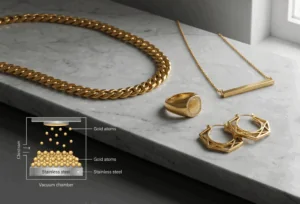
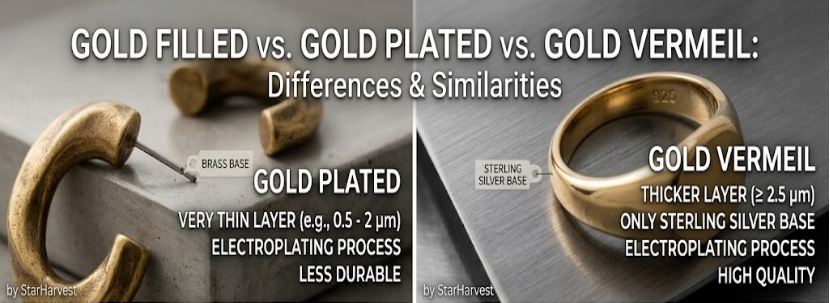
Manufacturing Process: Gold plating involves depositing an ultra-thin gold layer (typically 0.05-0.5 microns) onto a base metal through electroplating or PVD coating. At Star Harvest, we use advanced PVD technology on stainless steel bases, which offers superior adhesion compared to traditional electroplating on brass.
Quality Control Insights:
- Coating thickness testing: Our 7 patented electroplating processes ensure uniform thickness within ±0.02 microns
- 48-hour salt spray test results: Standard electroplated gold plating shows visible tarnishing after 24 hours; our PVD gold plating on stainless steel maintains luster beyond 48 hours
- Wear resistance data: In our 300× rolling tests, traditional gold plating begins to show wear at approximately 150 cycles
B2B Considerations:
- Best for: Fast-fashion brands with rapid product turnover (3-6 month lifecycle)
- Manufacturing lead time: 25-30 days for bulk orders
- Cost optimization: 15-20% lower production costs compared to vermeil or filled options
- Return rate data: Brands report 8-12% returns due to tarnishing within first 6 months
Gold Vermeil: The Middle-Ground Solution
Manufacturing Process: Gold vermeil requires a sterling silver (925) base with a minimum 2.5-micron gold layer applied through electroplating. This creates a thicker, more durable coating than standard plating.
Quality Control Insights:
- Base metal verification: Every sterling silver batch undergoes composition testing to confirm 92.5% silver content
- Coating adhesion testing: Our 1.5KG+ tensile tests show vermeil maintains integrity under stress that would break standard plating
- Thickness precision: Star Harvest’s German equipment ensures coating uniformity within ±0.1 microns across entire production runs
B2B Considerations:
- Best for: Mid-tier brands positioning as “affordable luxury”
- Manufacturing complexity: Requires stricter quality controls due to base metal costs
- Lifespan expectancy: 1-2 years with normal wear
- Market positioning: Allows 40-60% margin while maintaining quality reputation
Gold Filled: The Premium Alternative
Manufacturing Process: Gold filled jewelry consists of a thick gold layer (minimum 5% of total weight) mechanically or chemically bonded to a brass or silver core. This creates the most durable gold-filled jewelry option outside of solid gold.
Quality Control Insights:
- Weight verification: Each batch undergoes precise weighing to confirm 5%+ gold content
- Bond strength testing: Our mechanical bonding process withstands 2.0KG+ tensile force
- Durability data: In accelerated aging tests, gold filled jewelry shows minimal wear after 500 hours of simulated use
- Chemical resistance: Salt spray tests demonstrate no visible degradation after 72+ hours
B2B Considerations:
- Best for: Brands building long-term customer relationships and encouraging jewelry investments
- Manufacturing precision: Requires advanced equipment and skilled technicians
- Expected lifespan: 3-5 years minimum, up to 10+ years with proper care
- Customer satisfaction: Brands report <2% quality-related returns
Critical Manufacturing Differences That Impact Your Brand
Production Quality Control Requirements
From our factory floor experience managing 300,000-500,000 pieces monthly, here’s how quality control complexity varies:
Gold Plated:
- 5 quality checkpoints in production
- Standard inspection equipment sufficient
- Faster production cycle (15-20 days post-sampling)
Gold Vermeil:
- 7 quality checkpoints required
- Specialized testing for base metal purity
- Additional coating thickness verification
- Moderate production cycle (20-25 days)
Gold Filled:
- 9 comprehensive quality checkpoints
- Precision weight measurement systems required
- Bond strength testing equipment necessary
- Extended production cycle (25-35 days)
Surface Treatment Technology Comparison
Star Harvest’s proprietary SH-D Electroplating Technology offers distinct advantages across all three categories:
Standard Industry Practice vs. Star Harvest Approach:
| Aspect | Industry Standard | Star Harvest Technology |
| Coating uniformity | ±5% variation | ±1% variation |
| Color retention after 6 months | 70-80% | 90-95% |
| Adhesion strength | Baseline | 2-3× stronger |
| Tarnish resistance | 6-12 months | 12-24+ months |
Strategic Sourcing Recommendations for B2B Buyers
Match Material to Your Brand Strategy
Choose Gold Plated If:
- Your brand focuses on trend-driven, seasonal collections
- Target market expects <$50 retail price points
- Product lifecycle is 6-12 months maximum
- Volume is high (10,000+ units per SKU)
Choose Gold Vermeil If:
- You’re positioning as “accessible luxury”
- Target customer values hypoallergenic materials
- Retail price range is $80-$200
- Building repeat customer base
Choose Gold Filled If:
- Your brand emphasizes sustainability and longevity
- Targeting customers making jewelry investments
- Retail price point is $150-$400
- Customer retention is core business model
Supply Chain Risk Management
Based on managing 200+ brand partnerships, here are common sourcing mistakes and how to avoid them:
Mistake #1: Choosing material based solely on unit cost
- Impact: High return rates negate initial savings
- Star Harvest Approach: We help brands calculate total cost of ownership, including customer service costs, return shipping, and brand reputation impact
Mistake #2: Inconsistent quality between sampling and production
- Impact: First bulk order doesn’t match approved samples
- Star Harvest Solution: Our 9-step quality control system with documented process parameters ensures 97% on-time delivery with matching quality
Mistake #3: Underestimating lead time requirements
- Impact: Stock-outs during peak selling seasons
- Star Harvest Advantage: Our transparent production tracking system provides real-time updates, allowing brands to plan inventory accurately
Quality Verification: What to Demand from Your Manufacturer
Essential Documentation for Each Material Type
For Gold Plated Orders:
- Coating thickness test report (specify minimum microns)
- Salt spray test results (minimum 24-48 hours)
- Base metal composition certificate
- Nickel-free certification (EU compliance)
For Gold Vermeil Orders:
- Sterling silver purity certification (925 standard)
- Gold coating thickness verification (minimum 2.5 microns)
- Adhesion strength test results
- Hypoallergenic testing documentation
For Gold Filled Orders:
- Gold weight percentage verification (minimum 5%)
- Bond strength test results
- Accelerated aging test data
- FTC compliance documentation
Technical Manufacturing Specifications
Understanding Production Parameters That Affect Quality
Critical Factors in Gold Plating:
- Plating bath temperature (±2°C tolerance required)
- Current density uniformity
- Base metal surface preparation quality
- Post-plating treatment processes
Gold Vermeil Complexity:
- Sterling silver base quality directly impacts final appearance
- Thicker coating requires longer plating time
- Surface preparation is more critical than standard plating
- Quality control must verify both base and coating
Gold Filled Manufacturing Challenges:
- Achieving uniform gold layer distribution
- Maintaining precise weight ratios
- Ensuring strong mechanical/chemical bonding
- Preventing delamination under stress
Environmental and Ethical Considerations
Sustainability Impact by Material Type
At Star Harvest, our RJC certification requires us to track environmental impact across our production:
Gold Plated:
- Lowest gold content = smallest environmental footprint per unit
- Shorter lifespan = higher replacement frequency
- Chemical use in electroplating process requires proper waste management
Gold Vermeil:
- Sterling silver mining has significant environmental impact
- Moderate lifespan balances resource use
- Recyclability of silver base is advantage
Gold Filled:
- Higher gold content but 3-5× longer lifespan
- Best cost-per-wear environmental ratio
- Highly recyclable at end of life
Star Harvest’s Commitment:
- All materials sourced from RJC-certified suppliers
- Waste water treatment meeting ISO 14001 standards
- 90+ eco-friendly surface treatment options available
- Recycling program for production waste
Why Manufacturing Partnership Matters More Than Material Choice
The Star Harvest Difference in B2B Jewelry Manufacturing
After 20 years and 37+ million pieces produced, we’ve learned that material selection is just one factor in brand success. Equally important is your manufacturing partner’s:
Technical Capabilities:
- 7 patented electroplating technologies
- Quality laboratory with precision testing equipment
- German machinery for consistent output
- 30+ process innovations
Quality Systems:
- 9 quality control checkpoints
- 97%+ production pass rate
- Real-time defect tracking
- Batch traceability
Operational Excellence:
- 97% on-time delivery rate
- 500-700 new designs monthly
- 45-day standard lead time
- Transparent production updates every 48 hours
Business Partnership:
- Dedicated engineering, production, and QC team per client
- Daily production meetings
- Quarterly trend consultations
- Cost optimization strategies (15-20% savings vs. industry average)
Common Questions from Our B2B Partners
Q: Can we mix materials within one collection? A: Absolutely. We often recommend strategic mixing: gold filled for hero pieces, vermeil for core items, and plated for trend-focused pieces. This optimizes cost while maintaining quality perception.
Q: How do we prevent quality inconsistency between samples and bulk production? A: Star Harvest’s solution: We document exact process parameters during sampling and lock them into our production system. Our 97% first-batch approval rate reflects this discipline.
Q: What minimum order quantities are required for each material? A: Our MOQs vary by complexity, but we support brands at different growth stages:
- Gold Plated: 500-1,000 units per SKU
- Gold Vermeil: 300-500 units per SKU
- Gold Filled: 300-500 units per SKU
Q: How can we verify gold content in finished products? A: We provide X-ray fluorescence (XRF) testing reports showing exact gold layer thickness and composition. This is standard with every Star Harvest order.
Q: What certifications should we require? A: Minimum: Material safety certificates, nickel-free testing, and basic quality reports. Star Harvest provides RJC, SGS, ISO 9001, and ISO 14001 certifications as standard.
Conclusion: Strategic Material Selection for Brand Growth
Gold filled, gold plated, and gold vermeil each serve distinct brand strategies and customer segments. The key is aligning your material choice with your business model, customer expectations, and long-term brand vision.
Key Takeaways:
- Material quality directly impacts customer retention: Higher-quality materials reduce returns and increase repeat purchases
- Manufacturing expertise matters as much as material: A skilled OEM partner like Star Harvest can optimize quality and cost within any material category
- Calculate total cost of ownership: Unit price is just one factor; include returns, customer service, and brand reputation impact
- Verify quality through documentation: Insist on material certificates, testing reports, and process traceability
- Build partnerships, not just transactions: Choose manufacturers who invest in your brand’s success through technical support, trend insights, and operational excellence
Partner With Star Harvest for Your Next Collection
Since 2005, Star Harvest has helped over 200 jewelry brands optimize their material choices and manufacturing processes. Our combination of advanced technology, rigorous quality control, and customer-centric approach has enabled our partners to achieve an average 45% performance growth.
Why brands choose Star Harvest:
- 20 years of OEM/ODM expertise in brass and stainless steel jewelry
- 7 patented electroplating technologies offering 2-3× better performance
- RJC, SGS, and ISO certifications ensuring ethical, responsible manufacturing
- 97% on-time delivery rate with transparent production tracking
- 500-700 new designs monthly to keep your collections fresh
- Cost optimization strategies delivering 15-20% savings
Ready to discuss your next jewelry collection?
Whether you need 500 samples for market testing or 200,000 units for a major launch, our team is ready to transform your designs into market-ready products.
About the Author: This guide is compiled by Star Harvest’s engineering and quality control teams, drawing on 20 years of B2B jewelry manufacturing experience and data from over 37 million pieces produced for global brands. All technical specifications and testing data reflect Star Harvest’s actual quality control standards and manufacturing capabilities.