
For jewelry brands and retailers, pearl wedding jewelry represents a perennial revenue stream that transcends fleeting trends. While the end consumer sees romance and tradition—evoking the timeless elegance of icons like Grace Kelly—procurement managers and brand directors must see the technical precision required to build a profitable line.
Creating a scalable, high-quality bridal collection starts with a deep understanding of the raw materials. The wrong pearl choice can compromise your brand’s reputation for quality, while the right sourcing strategy ensures high perceived value and customer satisfaction.
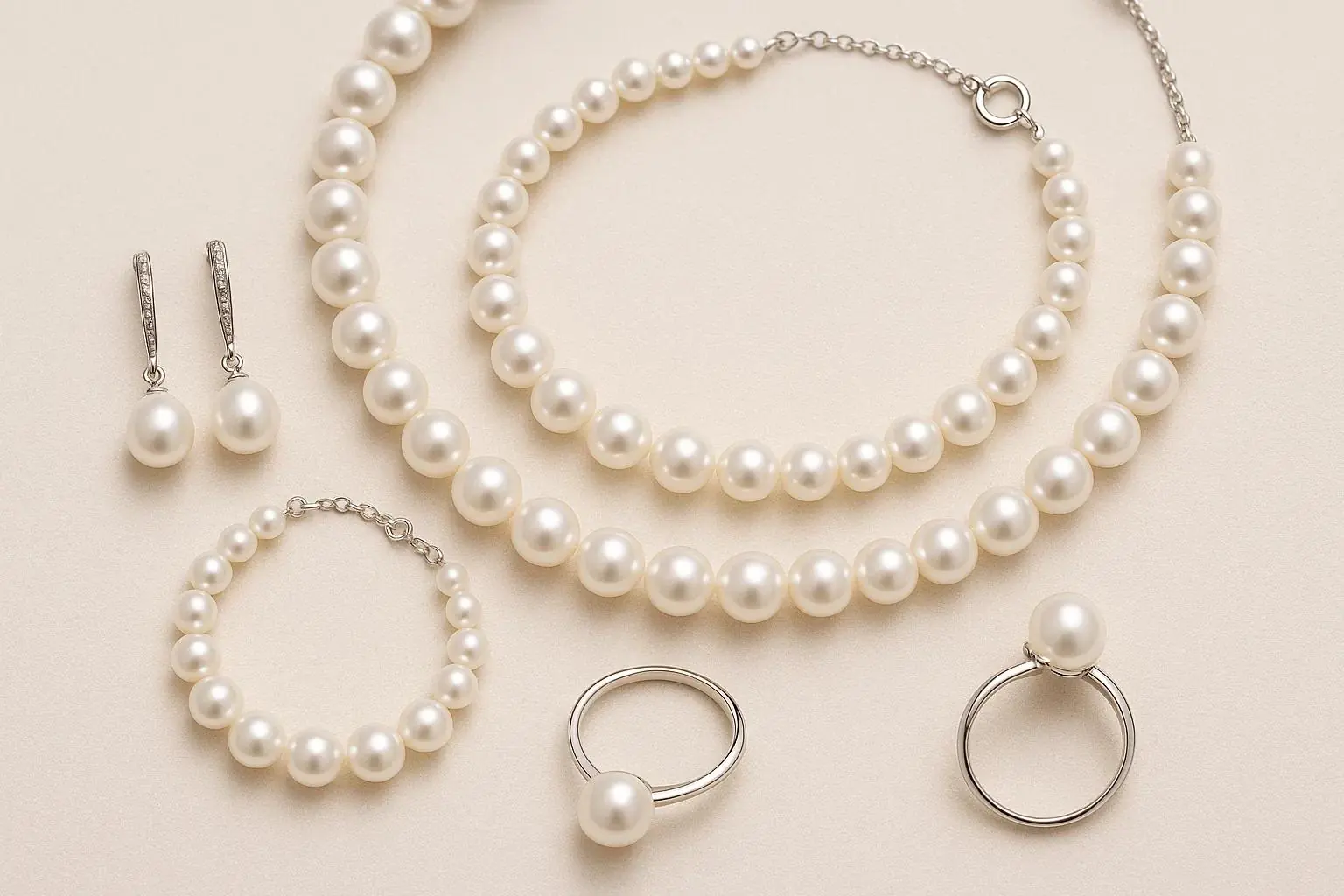
Pearl Types for Wedding Jewelry
When curating pearl wedding jewelry sets, understanding the distinct characteristics of pearl types is critical for defining your price points and target demographics in the Australian market.
1. Freshwater Pearls: The Versatile Volume Driver
For brands targeting the mid-market or fashion-forward demographic, Freshwater pearls offer unrivaled versatility. Predominantly cultivated in China, they are the most affordable option, allowing for healthy profit margins.
While they may lack the mirror-like sharpness of Akoya pearls, high-quality Freshwater pearls offer excellent durability due to their solid nacre composition.
They are available in a vast array of shapes, including the increasingly popular baroque forms, making them ideal for modern, bohemian bridal designs where “perfectly imperfect” is the selling point.
2. Akoya Pearls: The Classic Standard
When a customer envisions a traditional strand of pearls, they are picturing Akoya. Cultivated primarily in Japan and sometimes Australia, Akoya pearls (typically 6mm–8mm for bridal wear) are renowned for their ball-bearing roundness and sharp, mirror-like luster.
For premium pearl jewelry wedding collections, Akoya is the standard. They command a higher price point than Freshwater pearls, appealing to the traditional bride seeking investment-grade elegance.
Their subtle overtones of rose, silver, or cream complicate the matching process, requiring strict quality control during procurement.
3. South Sea Pearls: The Luxury Tier
For high-end collections targeting the affluent Australian bride, South Sea pearls are the pinnacle. Harvested in the warm waters of Australia, Indonesia, and the Philippines, these are the largest commercially harvested cultured pearls (9mm–16mm+).
Their luster is softer and more satiny than the Akoya. The White South Sea pearl, specifically the Australian variety, is prized for its pure, brilliant white hue. Including these in a collection creates a “halo effect,” elevating the perceived prestige of your entire brand catalog.
4. Tahitian Pearls: The Modern Statement
While white remains the bridal standard, there is a growing niche for the bold, non-traditional bride. Tahitian pearls, cultivated in French Polynesia, offer natural dark hues ranging from slate grey to peacock green and aubergine.
Ranging from 8mm to 14mm, they possess a metallic luster that photographs exceptionally well. Integrating Tahitian pearls into pearl wedding jewelry sets for brides allows a brand to capture the alternative luxury market segment.
The 5 Factors of Pearl Quality: A Procurement Guide
To ensure consistency across your inventory, your quality control (QC) standards must be rigorous. Focusing on the following five factors is essential for commercial viability.
1. Luster
Luster is the most critical value factor. It is the intensity of light reflected from the pearl’s surface. High-luster pearls reflect light sharply, like a mirror, while low-luster pearls appear milky or chalky. In a competitive market, luster is often the deciding factor for the consumer.
Pro Tip: Luster is directly linked to nacre thickness. Thick, tightly layered nacre not only produces a deep, iridescent glow (orient) but also ensures the pearl’s durability against wear—a key selling point for heirloom-quality wedding jewelry.
2. Surface Quality
Pearls are organic, so minor blemishes are expected. However, for bridal collections, the surface should be clean to the naked eye. Heavily spotted pearls (pitting, bumps, or wrinkles) significantly devalue the piece and can weaken the pearl’s structure.
3. Shape
While perfectly round pearls command the highest premiums (essential for Akoya), off-round and semi-baroque shapes are acceptable for Freshwater collections. The “drop” shape is particularly valuable for pendants and earrings in pearl wedding jewelry sets.
4. Color
This includes the body color and the overtone. For the Australian market, white pearls with rose (pinkish) or silver overtones are most desirable as they complement a wide range of skin tones. Consistency in color matching across a necklace or set is vital; a mismatch is an immediate indicator of low quality.
5. Size
Size equals presence. In the bridal sector, 7.0mm–7.5mm is the “sweet spot” for necklaces, balancing visibility with modesty. Larger pearls (9mm+) imply luxury and maturity, often preferred for mothers of the bride or high-net-worth clients.
How to Choose the Right Pearls for Your Bridal Collection
Building a successful line requires balancing aesthetic aspiration with commercial reality.
1. Define Your Brand‘s Aesthetic
Your pearl sourcing must align with your brand identity. If your brand is known for architectural, modern silver designs, the organic irregularity of baroque Freshwater pearls may fit better than the rigid formality of round Akoyas. Conversely, a heritage brand focusing on classic luxury must prioritize the perfection of South Sea or top-tier Akoya pearls.
2. Know Your Target Price Point
Reverse-engineer your collection from your target retail price.
- Entry-Level (<$300 AUD): Focus on high-luster Freshwater pearls set in 925 Sterling Silver.
- Mid-Range ($500–$1,500 AUD): Utilize smaller Akoya pearls or high-grade Freshwater pearls with complex settings.
- High-End ($2,000+ AUD): Incorporate South Sea pearls and gold accents. Understanding the price elasticity of your customer base prevents over-engineering the product.
3. Prioritize Luster Over Perfection
When managing costs for pearl wedding jewelry sets for brides, never compromise on luster. A slightly off-round pearl with brilliant, mirror-like luster will always outsell a perfectly round pearl that looks dull. Luster catches the eye in display cases and online photography; shape is often secondary to the overall glow.
4. Consider the Design & Wearability
Bridal jewelry must complement, not compete with, the gown.
- Necklines: Design V-drop pendants for V-necks, and classic princess-length strands (18″) for strapless gowns.
- Metals: The metal choice frames the pearl. Cool tones like Rhodium-plated Silver or White Gold enhance the brightness of white pearls, while Yellow Gold creates a vintage warmth.
- Comfort: Weight matters. A South Sea strand is heavy; ensure your clasps are secure and comfortable for all-day wear.
Manufacturing Excellence with Star Harvest
Executing a high-performing pearl category requires a manufacturing partner who understands both the organic nature of pearls and the precision of metalwork.
At Star Harvest, we specialize in OEM/ODM services for medium to large-scale jewelry brands. With over 19 years of experience, we combine premium pearl sourcing with expert metal craftsmanship. We ensure that every piece of pearl wedding jewelry meets rigorous quality standards, from the thickness of our rhodium plating to the precise matching of pearl overtones.
Whether you need sophisticated metal settings to complement freshwater pearls or intricate custom designs for a luxury collection, our BSCI-audited factory delivers the consistency your brand relies on. Partner with Star Harvest to scale your bridal collection with confidence and quality.