In the competitive landscape of the Australian jewelry market, established brands are constantly seeking high-margin opportunities. While single rings are a standard purchase, peridot jewelry sets present a unique proposition to increase Average Order Value (AOV).
For large-scale retailers and e-commerce brands, peridot sets offer a scalable, visually striking product line. However, producing a cohesive set requires strictly managing the gemstone’s consistency from earrings to pendant. This guide covers the journey from extraction to the retail showcase, with a specific focus on set creation.
Global Sourcing and Material Consistency for Sets
For a jewelry brand manager, the stability of the supply chain is paramount when planning multi-piece collections. The primary challenge in manufacturing jewelry sets is not just finding one good stone, but finding thousands of identical stones to ensure the earrings match the pendant perfectly.
While peridot is found globally, commercial set production relies on specific regions that can provide volume consistency:
- China: Holding the largest share of mineable rough, China is the backbone for mass-market jewelry sets. The sheer volume allows manufacturers to sort and match stones easily, preventing the issue where a necklace looks different from the earrings.
- United States: American peridot is a staple in the industry, often characterized by standard commercial sizes perfect for pavé work or accent stones in a peridot stone jewelry set.
- Pakistan: For high-end collections, the Supat region in Pakistan yields some of the finest crystals. These stones often boast better clarity and larger carat sizes, suitable for premium, limited-edition sets.
Peridot Quality Measurements for Matched Sets
When commissioning a peridot jewelry set, quality control is exponentially more difficult than with single rings. The earrings must match the pendant, which must match the ring. Here is the technical breakdown for QC teams.
1. Color Matching: The Vital Requirement
The ideal peridot is a pure grass green. However, the commercial reality is a spectrum from lime to olive.
- The Set Challenge: In a single ring, a slight olive tone is acceptable. In a set, if the earrings are electric lime and the pendant is olive green, the set looks disjointed and low-quality.
- The Solution: Manufacturers must use “Master Sets” rather than single master stones. Rough material must be pre-sorted specifically for sets to guarantee consistent saturation across the necklace, earrings, and ring.
2. Clarity Consistency
While top-tier peridot should be eye-clean, the focus for sets is uniformity of inclusions.
- QC Protocol: A hazy stone in a ring cannot be paired with crystal-clear earrings. For a cohesive peridot jewelry set, manufacturers must rigorously reject stones with visible black spots or uneven haziness, as these flaws become glaringly obvious when placed next to a cleaner matching piece.
3. Cut and Proportions
Because peridot has high double refraction, a skilled cut is necessary to maximize brilliance.
- Production Challenge: Cutting precision is vital for matched sets. If a necklace features a 10x8mm oval peridot, the accompanying earrings must be cut to exact proportions to reflect light identically.
- The Solution: Utilizing automated cutting technology ensures that the geometry matches across all pieces in a set, preventing the “mismatched” look that often plagues volume productions.
4. Calibrated Sizes for Scalability
- Commercial Sweet Spot: For scalable jewelry sets, calibrated sizes (e.g., 5mm rounds or 7x5mm ovals) are preferred over free-size cuts.
- Inventory Advantage: Using standard calibrated sizes allows brands to easily replace a lost earring or repair a ring without disrupting the set’s integrity—a crucial after-sales consideration for large retailers.
Technical Manufacturing Considerations
Manufacturing a set involves unifying different jewelry types (rings vs. earrings) under one design language while respecting the stone’s physical properties.
1. Durability and Setting Styles
A ring faces high impact, while earrings do not. A smart manufacturing strategy often uses bezel settings for the ring (for protection) while utilizing prong settings for the earrings/pendant (for maximum light). The challenge is to ensure these different settings still look like a “family” through consistent design motifs.
2. Metal Pairing Aesthetics
- Yellow Gold: This is the classic, Victorian-era choice. The rich yellow tones complement the olive green, creating a warm, vintage aesthetic that performs well in autumn/winter collections.
- White Gold / Platinum: Pairing peridot with white metals cools down the tone, making the green pop vividly. This combination is ideal for Art Deco designs or modern, geometric cuts like the emerald cut.
When producing sets, the plating color (e.g., 14k vs 18k tone) must be rigorously consistent. A slight variation in metal color between the chain and the ring shank will be immediately noticeable to the customer.
Best-Selling Peridot Jewelry Set Configurations
To maximize sell-through rates, brands should focus on configurations that have proven historical data.
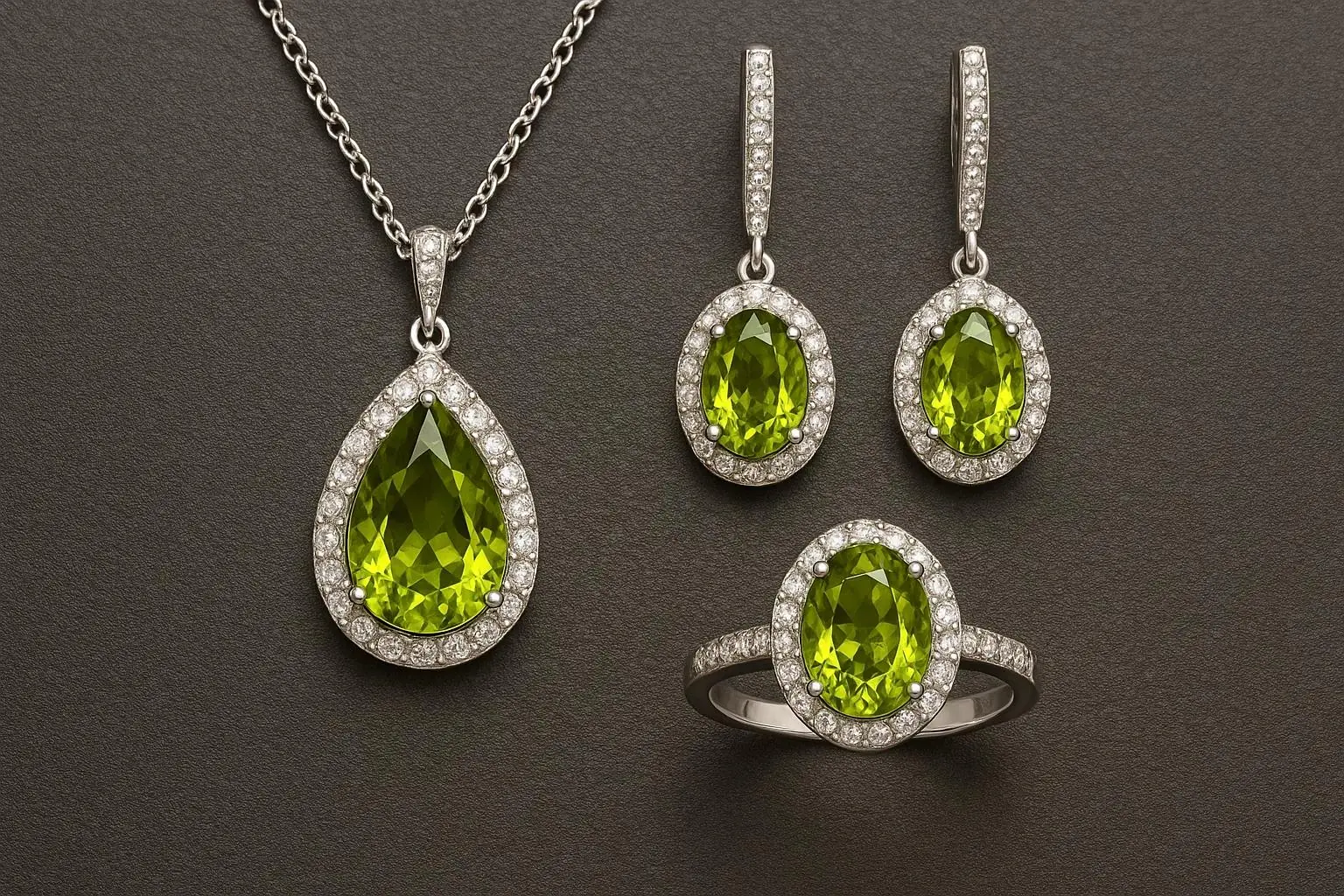
1. The “Holy Trinity” Configuration
The standard best-seller remains the three-piece suite:
- Pendant: Usually a solenoid design, 1-2 carats.
- Earrings: Matching studs or short dangles, slightly smaller than the pendant.
- Ring: The statement piece.
2. Modern Trend Sets
- Minimalist Geometrics: Using baguette or emerald-cut peridots in sleek bezel settings. This appeals to the modern office worker looking for a pop of color without the bulk.
- Nature-Inspired / Vintage: Capitalizing on the “green” trend. Designs featuring leaf motifs or floral halos using small diamond accents.
- Stacking-Friendly Designs: Instead of rigid sets, offering a peridot stone jewelry set designed to be stacked with other gemstones like White Topaz or Amethyst. This modular approach encourages repeat purchases.
Partner with Star Harvest for Scalable Manufacturing
For medium to large-scale brands, reliable sourcing and manufacturing precision are vital. Star Harvest excels as a specialist OEM/ODM manufacturer with over 20 years of experience, focusing on high-quality brass and stainless steel jewelry. We provide a premium yet cost-effective foundation for your peridot collections.
Our key advantages include:
- Strategic Sourcing: We utilize deep industry connections to source and sort natural peridot, ensuring strict color and clarity uniformity for every peridot jewelry set.
- Advanced Plating: To complement the vibrant green stone, we employ advanced PVD and heavy gold plating technology. This delivers the luxurious aesthetic of solid gold at a scalable price point, perfect for high-margin retail.
Whether you need vintage-inspired or modern minimalist designs, Star Harvest transforms your concepts into profitable reality.
Visit our OEM Jewelry Services to start your collection.