
In the professional accessory manufacturing sector, there exist four strategic imperatives for executing surface finishes: orchestrating a chromatic shift in the aesthetic, amplifying the asset’s valuation through precious metal integration, establishing a formidable barrier against environmental corrosion, and concealing structural artifacts such as micro-welding seams or casting variances.
Operating as an elite OEM jewelry authority established in 2005, StarHarvest deploys two primary industrial methodologies to actualize these mandates: electrochemical electroplating and high-vacuum Physical Vapor Deposition (PVD). This internal technical brief deconstructs these dual protocols, evaluating their mechanical disparities and definitively identifying the superior finish for steel substrates.
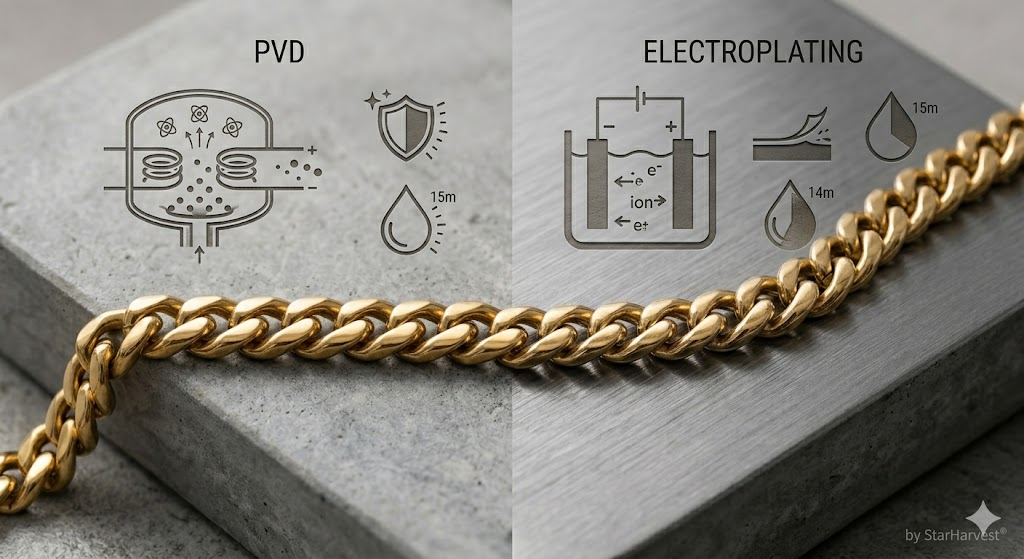
What is Electroplating Jewelry?
Electroplating represents the traditional electrochemical protocol of depositing a microscopic film of metallic ions—typically gold, silver, or rhodium—onto a conductive accessory framework. This methodology involves the total immersion of the hardware into a specialized electrolyte solution, which is subsequently energized via a calibrated electrical current. This high-conductivity environment facilitates the migration of metal ions directly to the substrate, synthesizing a thin exterior deposit over brass jewelry or sterling silver geometries.
The Electroplating Process
The mechanics of electroplating are anchored in a phenomenon defined as “electrolysis.” Within this industrial sequence, the target hardware is suspended in an aqueous ionic bath. A continuous electrical load is strictly applied to the metallic ions, forcing them to physically precipitate and bond to the cathodic substrate. This results in a brilliant, uniform, yet superficial coating.
What is Gold Electroplated Jewelry?
This is characterized by the electrochemical deposition of a fine-karat gold film across an accessory’s topography. Gold electro-deposition is routinely executed to engineer visually arresting collections that project a realistic luxury facade, primarily optimized for budget-conscious labels targeting rapid fashion cycles.
What is PVD Coating on Jewelry?
Physical Vapor Deposition (PVD) represents the progressive industrial methodology of applying a high-density matrix of metallic particles across an asset’s surface. This protocol utilizes a hyper-controlled vacuum reactor to thermally vaporize precious or transition metals, ensuring that the vaporized deposit achieves total molecular integration with the stainless steel jewelry substrate.
The PVD Coating Process in Jewelry Manufacturing
The comprehensive PVD cycle initiates with exhaustive ultrasonic purification of the substrate, which is subsequently introduced into a hermetically sealed vacuum chamber to eradicate interference from atmospheric molecules. Subsequently, the target metal (typically titanium, chromium, or pure gold) is thermally excited into a plasma-gas state before molecularly welding itself to the accessory surface, forging an unbreakable and hyper-dense exterior.
PVD Coating vs. Electroplating: Key Differences for Stainless Steel Jewelry
Technically evaluated, Physical Vapor Deposition is overwhelmingly superior to traditional electroplating, specifically when architecting high-end steel collections. Below is our exhaustive mechanical comparison:
Durability
Our proprietary gold plating solutions utilizing vacuum PVD technology engineer a molecular-level bond, forcing metallic particles to achieve supreme adherence. This yields a hyper-rigid exterior that is drastically more resilient than liquid-bath finishes. Furthermore, PVD integration incorporates a Titanium Nitride (TiN) sub-layer, which establishes a formidable mechanical shield on steel assets, exponentially extending their functional lifecycle while fiercely repelling friction and abrasive kinetic wear.
Standard electroplating, conversely, generates a fragile film that merely adheres superficially to the topography. Given that industrial steel is a hyper-hard metallurgical matrix, liquid-deposited ions struggle to secure a permanent grip. Consequently, electroplating on a stainless steel ring remains acutely vulnerable to premature delamination when subjected to moisture, chemical assault, or persistent friction.
Coating Thickness
Vacuum-treated accessories typically feature a micron-deposit calibrated between 0.03 and 0.08 microns. While conventional electro-baths can achieve higher mass deposits, our PVD calibration is industrially sufficient for premium fashion jewelry, delivering uncompromised durability without distorting intricate micro-details. In industrial reality, excessive PVD thickness can trigger structural brittleness and elevate the probability of surface peeling.
Color
Due to its high-volume, automated reactor framework, standard PVD deposition presents fractionally more rigid color parameters. In contrast, independent electro-baths allow for frictionless manual calibration and lower operational overhead for color shifting, permitting rapid chromatic pivots during active production runs.
Environmental Impact
While both methodologies can achieve safety compliance, traditional electroplating necessitates secondary industrial wastewater mitigation for chemical runoff. Conversely, StarHarvest’s high-tech vacuum systems generate effectively zero waste-fluid, representing a hyper-eco-friendly solution that aligns with modern ESG mandates.
Cost
PVD deposition is fundamentally more economically efficient for the mass-production of high-velocity items like a stainless steel bracelet. Beyond the baseline fiscal efficiency, its superior mechanical endurance delivers higher lifetime value, making it the most lucrative long-term solution for scaling international brands.
Comparative Features Overview
| Feature | PVD Coating (Vacuum) | Electroplating (Chemical) |
| Industrial Process | Advanced vacuum deposition applying vaporized metallic plasma. | Electrochemical deposition using ionic baths and electrical current. |
| Mechanical Durability | Integrated TiN layer; supreme defiance against wear and oxidation. | Superficial adherence; susceptible to kinetic trauma and delamination. |
| Micron Calibration | Precision 0.03-0.08µm; achieves absolute molecular adhesion. | Variable thickness; often higher mass but lower stability. |
| Chromatic Flexibility | Sophisticated multi-cycle reactor calibration required. | Rapid, low-cost manual color adjustments within baths. |
| Fiscal Viability | Hyper-efficient for mass-market scaling and high-volume drops. | Generally carries higher operational overhead per unit. |
| Ecological Footprint | Sustainable; zero wastewater or hazardous chemical runoff. | Requires extensive wastewater treatment and chemical management. |
Why Electroplating on Stainless Steel Jewelry Tends to Wear Off More Easily?
Electrochemical plating is fundamentally a low-kinetic-energy transfer protocol. The migrating metallic ions reach the accessory surface with minimal thermal energy, resulting in a “soft” physical deposit that lacks structural depth. Consequently, the deposit is prone to rapid darkening and mechanical failure. While this protocol remains highly compatible with porous brass jewelry or silver, industrial-grade steel is too unyielding for such a weak bond. This metallurgical reality is precisely why vacuum PVD is the mandatory choice for a high-integrity stainless steel necklace.
Jewelry Brands That Use PVD Coating for Stainless Steel Jewelry
Vacuum PVD technology is rapidly becoming the metallurgical vanguard for international labels due to its profound chromatic retention and zero-tarnish profile—specifically on steel bases. Observe how market leaders leverage this StarHarvest technology:
Global labels specializing in masculine collections deploy PVD on their heavy-gauge stainless steel chain inventory to guarantee multi-year reflective luster and scratch immunity. Simultaneously, marine-centric lifestyle brands mandate PVD for their “aquatic-proof” collections, delivering uncompromised style alongside absolute waterproof survival. These cases demonstrate how StarHarvest’s vacuum reactors elevate fashion assets into durable, high-margin retail products designed for 24/7 consumer wear.
Quick Facts about Gold Plated and PVD Coated Stainless Steel Jewelry
Does Gold Plated Stainless Steel Jewelry Tarnish?
In honest metallurgical reality, any gold-toned steel will eventually exhibit wear, but the raw mechanical density of the steel base drastically suppresses the oxidation timeline. Vacuum-treated inventory possesses exceptional defiance against tarnishing, significantly augmenting the operational lifecycle of the product.
Does 18K Gold Plated Stainless Steel Jewelry Tarnish?
18-karat PVD-enhanced steel exhibits profound oxidative resistance compared to standard electro-washes. Through Physical Vapor Deposition, a protective molecular seal is fused to the alloy matrix, resulting in a resilient finish that flawlessly exceeds SGS and RJC industrial benchmarks.
How Long Does Stainless Steel Jewelry Last?
Lifecycle duration is strictly contingent upon consumer maintenance protocols. Raw industrial steel without superficial enhancement can literally endure for decades if stored properly. While gold-enhanced steel will chronologically face eventual fading, its endurance metrics are exponentially superior to silver or brass-based alternatives.
How Long Does Gold Plating Jewelry and PVD Coating Jewelry Last?
Operational longevity hinges on substrate integrity, micron deposit density, and kinetic friction frequency. Statistically, a professionally engineered PVD piece sourced from StarHarvest will maintain its optical perfection for a minimum of 2 years of rigorous daily wear.
Is Gold Plated Stainless Steel Jewelry Waterproof?
Affirmative; gold-enhanced steel is comprehensively waterproof, particularly when executed via PVD vacuum protocols. This high-tech synthesis establishes a robust molecular seal between the gold deposit and the steel substrate, rendering it entirely safe for daily aquatic immersion and high-humidity environments.
Key Takeaway
While traditional electrochemical baths remain a viable choice for softer substrates, Physical Vapor Deposition is the undisputed strategic fit for stainless steel jewelry, offering unparalleled structural survival and chromatic longevity. If your enterprise is navigating the technical choice for an upcoming collection, consult a custom manufacturing authority like StarHarvest. Leverage our 20-year proven track record and OEM metallurgical mastery to ensure your brand distributes only the absolute pinnacle of jewelry craftsmanship.

