
Within the commercial accessory manufacturing sector, findings operate as the fundamental micro-architectural components strictly necessary for assembling and physically locking various jewelry constructs. From ultra-delicate neck chains to high-mass statement wristwear, comprehending the exact mechanics behind necklace closures, connection nodes, and earring backings is absolutely paramount for engineering long-lasting durability, ergonomic comfort, and distinct brand style.
As an elite OEM jewelry manufacturing facility operating globally since 2005, StarHarvest acutely understands that the dividing line between amateurish accessories and high-margin luxury pieces invariably lies within these microscopic hardware details. This extensive internal technical dossier navigates the entire spectrum of structural findings, detailing their mechanical purposes and delivering highly practical fabrication insights for brand founders and supply chain directors.
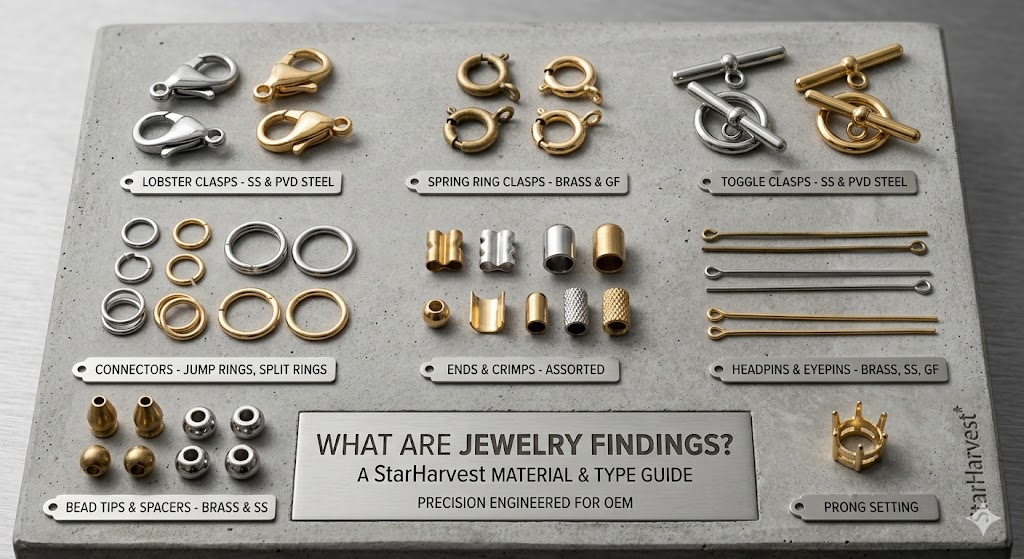
Definition of Jewelry Findings
In industrial terms, jewelry findings represent the utilitarian bridging mechanisms that flawlessly integrate isolated casting pieces into a singular, wearable product. The most prevalent variations include locking clasps, connecting jump rings, suspension bails, customized branding tags, and piercing hooks. Despite their microscopic dimensions, these structural nodes execute a colossal role in physically securing the asset while drastically elevating the perceived commercial value.
Mastering the mechanics of these specific attachments empowers brand architects to select the precise hardware necessary for achieving a premium, retail-ready finish. This calculated integration guarantees impeccable aesthetic cohesion and ensures severe longevity across your entire inventory catalog.
Commonly Used Metals for Jewelry Findings
The base metallurgical substrate directly governs the hardware’s tensile strength, oxidative resilience, and dermatological safety profile. At StarHarvest, we mandate the exclusive use of superior-grade raw materials. Outlined below are our primary alloy configurations:
316L Stainless Steel:
Engineered for extreme environmental endurance, total waterproof capability, and zero oxidative degradation. This medical-grade, hypoallergenic alloy serves as the indestructible backbone for our globally distributed stainless steel jewelry production lines.
Sterling Silver (925):
Formulated strictly from a calibrated ratio of 92.5% fine silver and 7.5% structural copper. This precious alloy delivers an aristocratic, luminous facade ideal for highly intricate micro-components and luxury bridal collections.
Brass:
An exceptionally workable fusion of zinc and copper. It provides a highly economical yet weighty foundation that perfectly mimics the density of solid gold, rendering it the ultimate substrate for bespoke, complex brass jewelry architectures.
Gold (14K/18K) & PVD Plating:
Yielding an uncompromisingly affluent aesthetic. Through the deployment of our proprietary gold plating solutions, we execute advanced vacuum physical vapor deposition (PVD) to bond heavy gold layers over both brass and steel, achieving a zero-tarnish luxury standard.
Classification of Jewelry Findings
Deconstructing the distinct classifications of these micro-components will significantly streamline your technical design phase. They are systematically divided into three functional pillars:
Functional Findings
These mechanical units are non-negotiable prerequisites for the physical operation and structural stability of your inventory. Their primary mandate is utilitarian, creating the dynamic linkages necessary for everyday consumer wear. This category encompasses heavy-duty locking mechanisms, tensioned jump rings, anchoring bails, and piercing hooks.
Decorative Findings
Conversely, ornamental findings are explicitly deployed to magnify the visual opulence of the baseline casting. These visually striking additions include intricately stamped filigree cages, architectural chandelier extensions, ornate focal bails, and complex metallic bead caps.
Hybrid Findings
Hybrid units seamlessly fuse robust mechanical utility with avant-garde visual impact. Examples include massive, statement-making toggle closures, heavily textured structural connectors, and gem-encrusted suspension bails that physically support the piece while heavily dictating its stylistic narrative.
Common Types of Jewelry Clasps
A locking clasp is a micro-engineered mechanical gatekeeper designed to fasten chains and wristwear, delivering mandatory consumer security. The following closure architectures are industry standards:
Lobster Clasp
Operating via a highly dependable, spring-actuated internal pincer, lobster claws dominate the international hardware market. The overlapping jaw retracts smoothly via a manual lever and locks automatically, neutralizing the risk of accidental detachment during rigorous kinetic activity.
Spring Ring
Functioning on a parallel logic to the lobster variant, spring rings consist of a hollow circular tube concealing an interior coil. These extremely low-mass findings are optimal for razor-thin, minimalist chains, supplying exceptional lock security without disrupting the piece’s delicate geometry.
Jumbo Spring Ring
This upscaled iteration replicates the standard spring tube mechanics but utilizes a significantly expanded outer circumference. These robust, oversized closures are strategically integrated into high-weight statement pieces, serving simultaneously as a fail-safe lock and a bold, frontal focal feature.
Open Box Clasp
The box mechanism relies on a meticulously calibrated wedge—a tensioned metallic tongue—that audibly snaps into a geometric hollow chamber. This frictionless, high-security lock is heavily favored in premium tennis chains or vintage collections, frequently featuring pave-set stones across its surface.
S Clasp
Forged into a literal serpentine “S” silhouette, these primitive yet highly secure connectors are manually hooked into corresponding chain loops. This non-mechanical closure is deeply favored by heritage brands aiming to project a highly artisanal, hand-forged visual identity.
Toggle Clasp
A toggle system deploys a rigid horizontal crossbar that manually threads through a corresponding circular or geometric ring. Once passed through, the bar physically cannot retract without manual manipulation. These closures are incredibly effective on heavy stainless steel bracelet models, doubling as a central design motif.
Fold-over Clasp
Featuring a heavily reinforced, pivoting hinge, this clasp folds completely flat and locks aggressively via mechanical friction. It generates a seamlessly integrated, continuous metallic plane, making it the superior engineering choice for dense, heavy-link Cuban or Miami chain architectures.
Push Clasp
Frequently referenced in technical blueprints as a snap or slide closure, this mechanism involves dual interlocking plates operating on intense internal spring friction. These progressive findings grant a perfectly flush, invisible lock interface while maintaining absolute consumer security.
Common Types of Earring Findings
Piercing hardware must safely anchor the visual element to the human ear while counterbalancing the structural weight. Here are the most critical earring mechanisms:
French Hooks (Ear Wires)
Often documented as standard ear wires, these are ergonomically arched metallic threads designed to pass smoothly through the lobe via gravity, without requiring a rear locking clutch. They remain the undisputed champion for hanging drop styles due to their frictionless insertion.
Hinge Back
Hinged mechanisms implement a sophisticated pivot that audibly snaps into a locked rear channel, clamping the accessory safely to the dermis. This highly secure architecture is standard protocol for premium huggies and heavy hoops, completely eradicating the risk of lost rear backings.
Butterfly Back
Engineered with dual friction-scrolls mimicking butterfly wings, these micro-components slide directly down the piercing post. They generate intense mechanical grip, delivering an exceptionally secure fit while remaining highly intuitive for the end-user to detach.
Earring Posts
Linear, minimalist metallic shafts engineered to penetrate the lobe directly. Within the StarHarvest assembly lines, these piercing rods are exclusively fabricated from hypoallergenic medical-grade steel, ensuring the absolute highest safety parameters for all standard stud configurations.
Hoops
Symmetrical, continuous metallic wireframes that bridge seamlessly through the piercing, terminating in either a hidden wire insert or a mechanical hinge. The hoop configuration remains perpetually dominant across both high-fashion runways and casual demographic sectors.
Clip-On
Meticulously engineered for demographics lacking dermal piercings, these units leverage calibrated mechanical spring tension or manual screw-threads to grip the lobe. Advanced factory iterations now incorporate soft silicone cushioning to eliminate localized pressure pain while preserving ultimate holding strength.
Connectors and Fasteners for Jewelry
Linking agents flawlessly integrate multiple structural sub-assemblies, guaranteeing fluid articulation and overarching durability. The following connection matrices are globally ubiquitous:
Jump Rings
Undeniably the most vital foundational element in accessory fabrication. These basic wireframes (circular or oval) bridge isolated pendants to stainless steel chains and clasps. Manufactured in infinite gauge diameters, premium variants can be thermally welded closed for absolute fail-safe retention.
Split Rings
Operating exactly like miniaturized key-rings, split units feature an overlapping, double-rotation helical wire. They yield exponentially higher tensile resistance compared to standard jump rings, making them mandatory for high-stress keychains or hyper-heavy gravity pendants.
Extension Chains
Brief, flexible chain segments tethered to the terminal closure points. Fused seamlessly to the primary architecture, these extensions afford the final retail consumer complete ergonomic control, allowing for bespoke length adjustments and versatile layering options.
Pins
Fundamental wirework components integral to custom assembly. Flat-based “head pins” act as structural stoppers for creating vertical beaded drops, whereas “eye pins” feature a pre-tooled terminal loop, allowing artisans to chain multiple elements in sequence.
Bails
The specialized suspension bridges that anchor heavy focal pendants directly to the passing necklace. Standard fixed bails provide robust, immobile integration, while tension-based pinch bails utilize internal pegs to grip drilled crystals, simultaneously amplifying security and visual elegance.
Specialized Jewelry Findings
Advanced or highly customized collections require auxiliary hardware designed for branding, stone retention, or layout pacing:
Tag
Miniature stamped or laser-etched metal plaques serving as the ultimate authentication tool. These flat plates carry proprietary brand insignias or karat hallmarks (e.g., “18K” or “S925”), instantly amplifying the corporate identity and retail premium of the final product.
Settings
The precision-machined cavities that permanently lock precious gems or synthetic crystals into the alloy matrix. Bezel variants fully encapsulate the stone’s perimeter, while micro-prongs permit maximum light refraction—a technique rigorously deployed across our luxury stainless steel ring lines.
Spacer Beads
Microscopic metallic spheres injected between primary visual focal points. They function as kinetic buffers to prevent abrasive friction between fragile stones while simultaneously dictating the rhythmic, geometric pacing of the overall strand.
Spacer Bars
Multi-drilled parallel bridging plates engineered explicitly for layered or multi-strand architecture. These structural stabilizers physically force parallel chains apart, aggressively preventing the twisting, tangling, and chaotic nesting of complex necklaces.
Pin Backs
The concealed anchoring mechanisms for heavy enamel brooches and corporate lapel badges. Manufactured with robust tension-locking clutches or resilient rubber friction grips, they ensure the heavy visual element penetrates and securely holds to dense garment textiles.
The Impact of Jewelry Findings on Jewelry Quality
Strategic capital allocation toward elite-grade findings directly translates into flawless execution, indestructible product longevity, and skyrocketing brand loyalty.
Durability and Security
Micro-components cast from 316L steel, pure silver, or high-karat gold fiercely resist mechanical deformation and kinetic fatigue. A high-tension clasp secures the entire retail investment, whereas brittle, low-cost hardware invites catastrophic structural failure and massive customer return rates.
Comfort and Wearability
Any component sustaining perpetual dermal contact—such as piercing wires or heavy stainless steel necklace locks—must boast microscopically polished, burr-free margins. Sourcing truly hypoallergenic alloys radically eliminates contact dermatitis, facilitating safe, perpetual consumer wear.
Material Considerations
Is medical steel a viable substrate? Unequivocally. Elite matrices like 316L surgical steel, sterling silver, and solid brass yield immense tensile resistance, total oxidative defiance, and stunning optical finish. Surgical steel specifically dominates the sector due to its permanent tarnish immunity and raw structural fortitude.
Aesthetic Cohesion
World-class factory hardware exhibits flawless geometric symmetry, identical micron plating, and highly refined detailing, merging invisibly with the primary casting. Conversely, poorly machined hardware plagued by jagged casting seams instantly annihilates a brand’s luxury positioning.
Characteristics of High-Quality Jewelry Findings
Functional Performance
Elite findings must deliver frictionless, highly intuitive operability. Complex mechanical springs must actuate precisely without demanding excessive manual torque, and high-tension piercing clutches must slide smoothly while retaining a vice-like, comfortable grip on the earlobe.
Material Strength
Baseline material density is critical. Hardened alloys, particularly our specialized 316L medical steel, are mandatory for high-stress micro-parts. This specific industrial grade fiercely repels corrosive acids, environmental tarnish, and lipid buildup, rendering it the ultimate choice for vulnerable connection points.
Strength and Reinforced Construction
Exemplary hardware must survive severe kinetic testing. This entails heavily reinforced gate hinges on lobster claws, dense cross-sections on connecting bridges, and laser-fused jump rings that completely neutralize the possibility of sudden disengagement during heavy physical movement.
Ensuring Hypoallergenic Earrings While Maintaining Cost-Effectiveness
To effectively eliminate dermal rejection while aggressively optimizing Cost of Goods Sold (COGS), strategic material splicing is required. While 316L surgical steel is the undisputed champion for biocompatibility, it carries a higher raw material premium. At StarHarvest, we routinely engineer the heavy ornamental body of the earring using highly economical brass or 304 steel, but strictly laser-weld 316L medical steel exclusively for the penetrating piercing post, ensuring maximum profitability without ever compromising biological safety.
Preventing a Tennis Necklace from Flipping
Using Powder Metallurgy Molding
Necklaces reliant on cheap, mass-market silicone molds invariably suffer from internal instability, leading to severe rotational flipping. To systematically eradicate this flaw, StarHarvest executes heavy-duty, proprietary tooling via advanced powder metallurgy. This radically increases the basal density, locking the necklace flat against gravity.
Adjusting Structure and Angle
Microscopic misalignment during the linking phase induces immediate gravitational imbalance. To counteract this, our senior draftsmen recalibrate the actual stone seating at a highly specific, mathematically calculated 45-degree angle. This structural repositioning perfectly shifts the center of mass, forcing the piece to lay securely flush.
Selecting the Appropriate Clasp Type and Position
The deployment of a high-density closure serves as a critical counterweight mechanism. Integrating a heavy-gauge lobster claw or a solid, dense open box lock significantly improves the rearward weight distribution, stabilizing the anterior chain geometry.
Balancing the Chain and Pendant
Calculating the exact mass differential between the suspension chain and the focal drop is paramount. A flawlessly engineered blueprint guarantees a synchronized gravitational load, permitting the luxury asset to drape immovably across the clavicle without requiring continuous wearer adjustment.
Selecting Suitable Jewelry Findings for Your Design.
Type of Jewelry
The overarching silhouette governs the hardware specification. A high-mass, masculine Cuban chain mandates a deeply reinforced, oversized locking mechanism, whereas a minimalist, floating drop earring requires an ultra-lightweight, visually discreet wire to balance sophisticated aesthetics with continuous comfort.
Durability and Strength
Prioritizing heavy-gauge connection rings and high-tension mechanical closures is a non-negotiable mandate for safeguarding your product’s lifecycle. When engineered from elite, non-corrosive metals, these findings act as the ultimate insurance policy against structural collapse and component loss.
Design and Aesthetics
Micro-hardware must perfectly mimic the primary thematic visual language of the collection. Specifying precisely matched PVD color-tones and cohesive structural silhouettes ensures the functional hardware vanishes seamlessly into the overarching luxury facade, amplifying the perceived retail value.
Allergy and Skin Sensitivity Considerations
Demographics demand absolute biological safety. Specifying inert, clean matrices—namely 316L surgical steel, high-purity titanium, or rhodium-plated 925 silver—drastically mitigates the risk of allergic contact dermatitis. Prioritizing these clean alloys is a mandatory business strategy for capturing the highly sensitive consumer market.
Key Considerations When Designing with Jewelry Findings
Weight Considerations
The proportional mass load of the closure mechanism practically dictates the ergonomic viability of the final piece. A premium necklace lock must possess sufficient baseline density to efficiently counterbalance the forward weight of the focal pendant, preventing the chain from sliding backward up the neck.
Ease of Use
All mechanical hardware must prioritize frictionless consumer interaction. Miniature locks must be intuitively easy to engage and release single-handedly, fundamentally eliminating consumer frustration, minimizing technical complaints, and massively elevating long-term brand loyalty.
Compatibility
The core casting and its auxiliary micro-hardware must be intelligently paired to safeguard vulnerable aesthetic assets. For instance, high-hardness synthetic diamonds require rigid, light-maximizing prong mounts, whereas delicate, softer semi-precious cabochons must be shielded from impact via full-perimeter bezel walls.
Conclusion
Ultimately, jewelry findings are the covert, load-bearing architecture of every successful accessory line, seamlessly executing the critical balance between mechanical performance, structural survival, and aesthetic brilliance. By deeply understanding the physics of necklace closures, piercing retention, and linkage grids—and by executing production alongside a deeply vetted OEM facility like StarHarvest—your enterprise can source the exact hardware configurations necessary to dominate the market with highly secure, visually arresting, and permanently durable collections.

