
The Mohs Scale functions as an essential tool for geologists and gemologists. It is a widely recognized system for evaluating a gemstone’s hardness.
This article will explore the scale’s basics and also look at gemstone examples across different hardness levels.
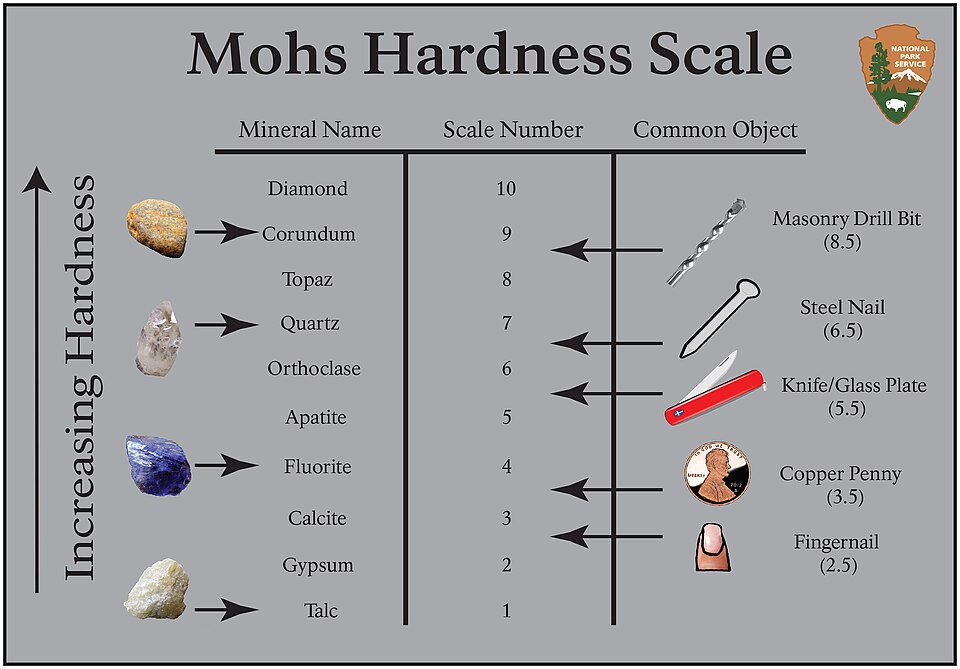
(Image Created by the National Park Service)
What Is the Mohs Scale?
The Mohs Scale is a standard system for measuring gemstone hardness. It basically measures the scratch resistance of minerals and shows how easily one mineral can scratch another.
History
German geologist Friedrich Mohs created this system in 1812. His method was based on scratch testing between minerals, using ten common minerals as reference points. Despite being over two centuries old, this system remains the global standard for assessing gemstone hardness.
Scale Range
The scale goes from 1 (softest) to 10 (hardest). Each number represents a specific reference mineral. Talc sits at 1, while diamond tops out at 10.
Ordinal Nature
Mohs Scale is ordinal, not linear. The difference between each number is not equal. For instance, the hardness gap between diamond (10) and ruby (9) is far greater than that between gypsum (2) and calcite (3).
What Does the Mohs Scale Measure?
The Mohs Scale measures hardness as resistance to scratching. It does not measure other properties like impact resistance. A hard mineral can still be brittle and break easily.
Examples of Gemstones and Their Mohs Hardness
Below are typical examples across the scale:
Soft Gemstones
Soft gemstones rate 1-4 on the scale and need special care. They are usually better suited for statement pieces, pendants, or limited-use designs.
- Talc(1)
This is the softest mineral with a hardness of 1. It feels soapy to touch, and can actually be scratched with a fingernail. It is used mainly for industrial or decorative purposes.
- Gypsum(2)
Gypsum rates 2 on the hardness scale. It is rarely used in jewelry either.
- Pearl(2.5-4.5)
Pearl requires protective settings and gentle care. It is ideal for luxury or classic collections emphasizing elegance over durability.
Medium-Hard Gemstones
These fall between the 5-7 range. They provide a good balance between beauty and practicality.
- Apatite(5)
Apatite measures 5 on the scale. It comes in blue, green, and yellow colors and works well for pendants and earrings.
- Opal(5.5-6.5)
Opal ranges from 5.5 to 6.5. It contains water, so it is sensitive to temperature changes. Extra protective settings are often needed.
- Quartz(7)
These rate 7 on the Mohs scale. Amethyst, citrine, and rose quartz are all basically the same in terms of hardness. They offer good durability for most jewelry uses.
Hard Gemstones
Hard gemstones rate 8-10 and offer excellent scratch resistance. They are ideal for daily jewelry wear.
- Topaz(8)
This gemstone measures 8 on the Mohs scale. It comes in many shades. These include blue, pink, and yellow. It is perfect for rings and bracelets.
- Corundum (9)
Corundum like ruby achieves a hardness of 9. It is a timeless choice for premium collections.
- Diamond(10)
Diamond is the hardest gemstone with a stone hardness of 10. No natural material can scratch it. It is mainly used for engagement and high-end jewelry lines.
Why the Mohs Scale Matters for Jewelry Brands
For jewelry brands, the Mohs Scale is more than a scientific reference; it’s a practical design and marketing tool.
Jewelry brands can select stones based on intended use, e.g., harder stones for daily-wear items and softer ones for limited-edition or ornamental pieces. Brands can also educate customers about gemstone care based on hardness to strengthen brand credibility.
At Star Harvest, we have over 20 years of experience in jewelry customization and extensive expertise in gemstone selection. From stone sourcing to setting, we offer reliable, one-stop OEM solutions for jewelry production.
Frequently Asked Questions (FAQs)
1. Can Two Minerals With the Same Mohs Hardness Scratch Each Other?
No. They might show minimal surface marking, but true scratches are unlikely.
2. Is the Mohs Scale the Only Way to Measure Hardness?
No. Other methods like Vickers, Rockwell, or Brinell tests offer more precise numeric values.
3. Can a diamond break if it is a 10 on the Mohs Scale?
Yes, a diamond can shatter. The Mohs Scale only measures hardness (resistance to scratching), not toughness (resistance to breaking or chipping). A hard blow at the right angle can cause it to crack or chip due to its internal crystal structure.
4. Why is household dust dangerous to jewelry?
Household dust often contains tiny particles of quartz, which has a hardness of 7 on the Mohs Scale. This means simply wiping dust off a softer gemstone (like an Opal, Moonstone, or Turquoise) with a dry cloth can cause microscopic scratches. Always rinse with water first.
5. Is gold harder than gemstones?
No, gold is actually quite soft. Pure gold (24K) ranks only about 2.5 on the Mohs Scale, while 14K or 18K gold is slightly harder due to alloy metals. This is why metal settings often get scratched by the gemstones they hold, or by harder surfaces they come into contact with daily.
Wrapping-up
In a nutshell, the Mohs Scale provides practical guidance for gemstone selection and care. It helps brands balance beauty, durability, and practicality and make informed design and sourcing decisions.

