
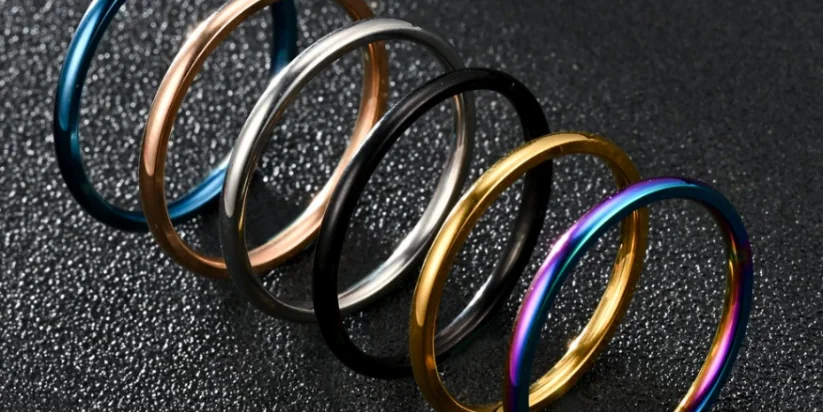
When partnering with jewelry manufacturers, product managers and buyers often encounter two primary surface treatment options: Physical Vapor Deposition (PVD) and Electroplating. While both methods aim to deposit a metal layer onto a substrate, their chemical processes, durability profiles, and environmental footprints differ.
This article dives deep into the PVD vs electroplating debate and provides the insights necessary for established brands to make informed manufacturing decisions.
PVD vs Electroplating: A Technical Comparison
To the untrained eye, a gold-finished ring looks the same whether it was plated or PVD coated. However, for a brand promising longevity and quality, the difference is profound.
1. The Process
The fundamental difference lies in how the coating is applied. Electroplating is an electrochemical process. The base jewelry piece acts as a cathode in an electrolytic bath. When an electric current is applied, metal ions (such as gold) are deposited onto the surface of the jewelry.
PVD (Physical Vapor Deposition) is a vacuum-based coating process. It takes place in a high-vacuum chamber where solid metal is vaporized into a plasma of ions. These high-energy ions are then bonded to the jewelry surface and often react with gases like nitrogen to create hard, colored compounds.
2. Common Coating Metals
Electroplating uses the specific metal element required for the finish, including gold, silver, rhodium, and copper.
PVD, however, typically uses reactive metals like titanium, zirconium, or aluminum. Through the introduction of reactive gases, these metals form hard ceramics on the surface.
3. Base Metal
This is perhaps the most critical distinction for your supply chain.
Electroplating is the standard for silver and brass substrates. These metals are conductive and accept electro-deposition readily.
PVD Coating is the industry standard for stainless steel jewelry since stainless steel. Since stainless steel forms a passive oxide layer that makes chemical bonding difficult, PVD is a more suitable method. Its high-energy vacuum process blasts through this layer to create a superior molecular bond and lasting durability.
4. Adhesion and Durability
Adhesion determines lifespan. PVD coatings are formed by high-energy ions striking the surface, resulting in a bond that is partly diffused into the substrate’s crystal lattice. This creates superior adhesion. PVD coatings are extremely hard and resistant to scratches, sweat, and corrosion.
Electroplating, while capable of achieving decent thickness (measured in microns), relies on a surface layer bond. If the plating is too thin (flash plating), it can rub off quickly. Even heavy electroplated jewelry is generally softer and more prone to scratching than a PVD finish.
5. Environmental Impact
For the German market, where sustainability is a major consumer driver, PVD has a distinct advantage. It is a “clean” technology that produces no hazardous liquid waste.
Electroplating traditionally involves harsh chemical baths, including cyanides and acids, which require rigorous waste management to prevent environmental contamination. While modern closed-loop systems have improved this, PVD remains the greener choice for eco-conscious brands.
6. Uniformity
PVD provides a highly uniform deposit that replicates the original surface texture perfectly. However, because it is a “line-of-sight” process, complex geometries require rotating fixtures in the vacuum chamber to coat every angle.
Electroplating excels at covering all conductive surfaces submerged in the tank. However, it suffers from “current density” issues. Areas with sharp edges or corners attract more current, leading to a thicker build-up, while recessed areas may receive a thinner coating.
Key Insights for Jewelry Brands
When developing your next collection, the choice between PVD vs electroplating should be dictated by your material selection and design intricacy.
1. When to Choose Electroplating
If your brand focuses on Sterling Silver or Brass collections, electroplating is usually the preferred route.
- Temperature Sensitivity: PVD processes often require temperatures between 200°C and 500°C. Soft metals like lead-free pewter, zinc alloys, or even some solders used in brass jewelry can deform, melt, or off-gas at these temperatures, ruining the batch.
- Thermal Expansion: Copper and silver expand significantly when heated. If a hard PVD coating is applied to a soft, expanding base, the “eggshell effect”can occur. Electroplating operates at lower temperatures, avoiding this risk entirely.
2. When to Choose PVD
For brands leveraging the “waterproof” or “tarnish-free” trend, stainless steel with PVD is the winning combination.
- Superior Adhesion: Stainless steel’s natural passive oxide layer can make electroplating difficult without aggressive acid activation (like Wood’s Nickel). PVD blasts through this oxide layer in the vacuum, ensuring a bond that will not peel.
- Longevity: German consumers value durability. A PVD-coated stainless steel bangle can withstand daily showers, gym sessions, and friction for years without fading, whereas electroplated gold jewelry on steel may eventually reveal the grey steel underneath if the plating is thin.
3. Design Considerations: Intricate Details
For pieces with deep recesses, filigree, or complex 3D structures, electroplating offers distinct reliability advantages.
- Throwing Power: Electroplating solution flows into every crevice, ensuring that even hidden inner channels are coated (provided there are drainage holes). PVD vapor travels in straight lines; deep recesses or shadowed areas might remain uncoated if the vapor cannot reach them directly.
- Edge Build-up Management: While electroplating can cause build-up on edges, experienced manufacturers utilize auxiliary anodes and current shields to control this, ensuring sharp details remain crisp.
Star Harvest: Your Trusted Jewelry Manufacturing Partner
Navigating the technical trade-offs between PVD and electroplating requires a manufacturing partner who is not just a vendor, but a technical consultant. Star Harvest stands out as a premier OEM/ODM solution for brands targeting the European market.
We understand that a “one-size-fits-all” approach does not work in jewelry customization.
- Expertise in Both Worlds: Unlike factories that only offer one type of plating, Star Harvest maintains advanced capabilities in both PVD vacuum coating and precision electroplating. We can guide you to the right choice based on your specific design and price point.
- Material Versatility: Whether your collection is copperrequiring heavy gold electroplating or stainless steel requiring gun-black PVD, we have the specialized lines to handle it.
- Quality First: We balance aesthetic brilliance with production efficiency. Our rigorous QC protocols ensure that electroplated pieces are free from edge build-up and PVD pieces have consistent color uniformity across the entire batch.
For medium-to-large brands, the finish is the first promise you make to your customer. Partner with Star Harvest to deliver jewelry that shines as brilliantly in year two as it did on day one.

