
Mercatus gemmarum se restructurat circa novum genus emptoris. McKinsey et Negotium Fashion’s Status Fashion 2026 relatio identificat gemmas ut celeriter crescentem modum fashionis per unitates venditionis, crescens fere quater rate vestium, cum tam costume quam bona gemmae praedicta crescere 5.3–5.6% annuatim usque ad 2028.¹ Venditiones gemmarum notatarum creverunt 8.3% per annum ab 2021 ad 2024, fere duplicando 4.2% incrementum segmentorum non notatarum.²
Hae numeri narrant fabulam incrementi. Sed maior mutatio non est in quantum gemmae venduntur — sed in quo eas emit, cur eas emit, et quomodo eas invenit. Hic articulus explicat quinque mutationes structurales in consuetudine consumptorum gemmarum et quid unaquaeque significet pro consilio productorum notae, mercatu gemmarum, et decisionibus fabricandis.

Revolutio Sui-Emptionis
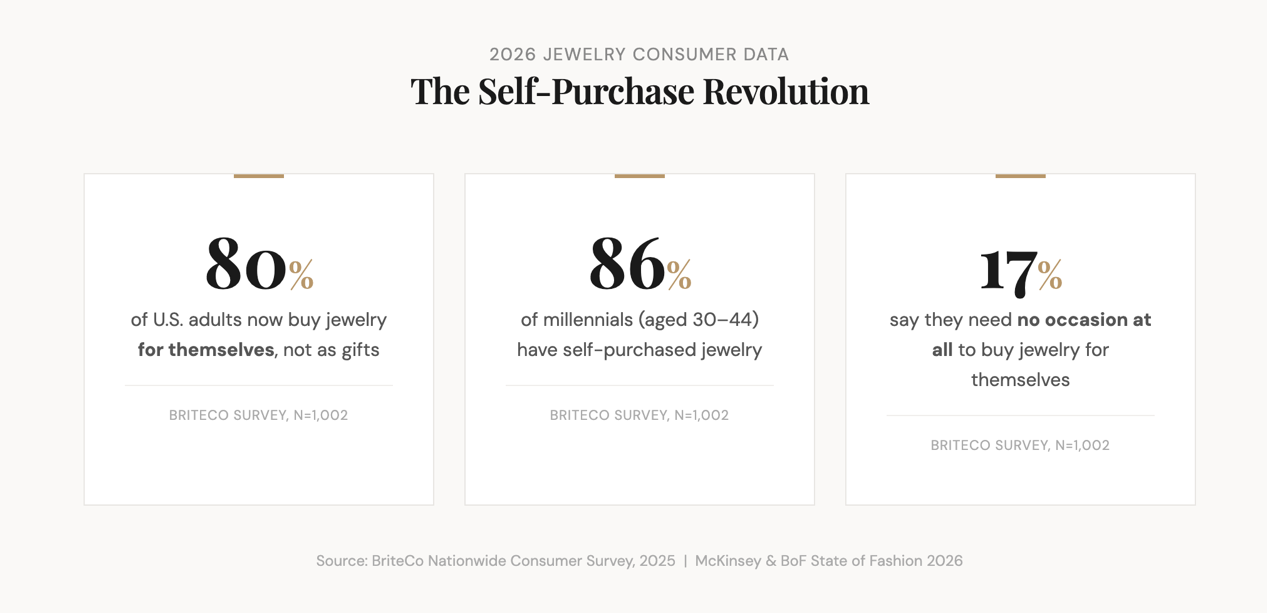
Plures gemmarum emptores in 2026 emunt pro se ipsis, non ut dona pro aliis. BriteCo pervagata inquisitione 1,002 adultorum U.S. invenit 80% nunc emere gemmas pro se ipsis, cum millennials (aetate 30–44) ducens ad 86%.³ Inter eos sui-emptores, 17% nuntiaverunt nullam occasionem specialem ad emptionem facere necessariam.³ Relatio McKinsey 2026 hoc confirmat ad globalem gradum, attribuens gemmarum validum volumine postulationis partim ad “auctum in sui-donatione inter tam viros quam feminas.”¹
Hoc non est parvum mutatio comportamentalis. Mutat quem notae loqui debeant. Traditum mercatum gemmarum circum “ille emit pro illa” narrationem — dies Valentini campaniae, imagines propositi, positiones donorum — ad parvam partem actualis piscinae emptorum pertinet.
Pro notis, hoc significat consilium productorum et nuntiationem debere centrare in indutore directe. Sui-emptores prioritizant quotidianam usum, expressionem personalis stili, et versatilitatem per occasiones. Minus moventur a presentatione in donis et magis a quomodo pars in eorum cotidiana rotatione conveniat.
“Pauca, Meliora” et Pressio Pretii Auri
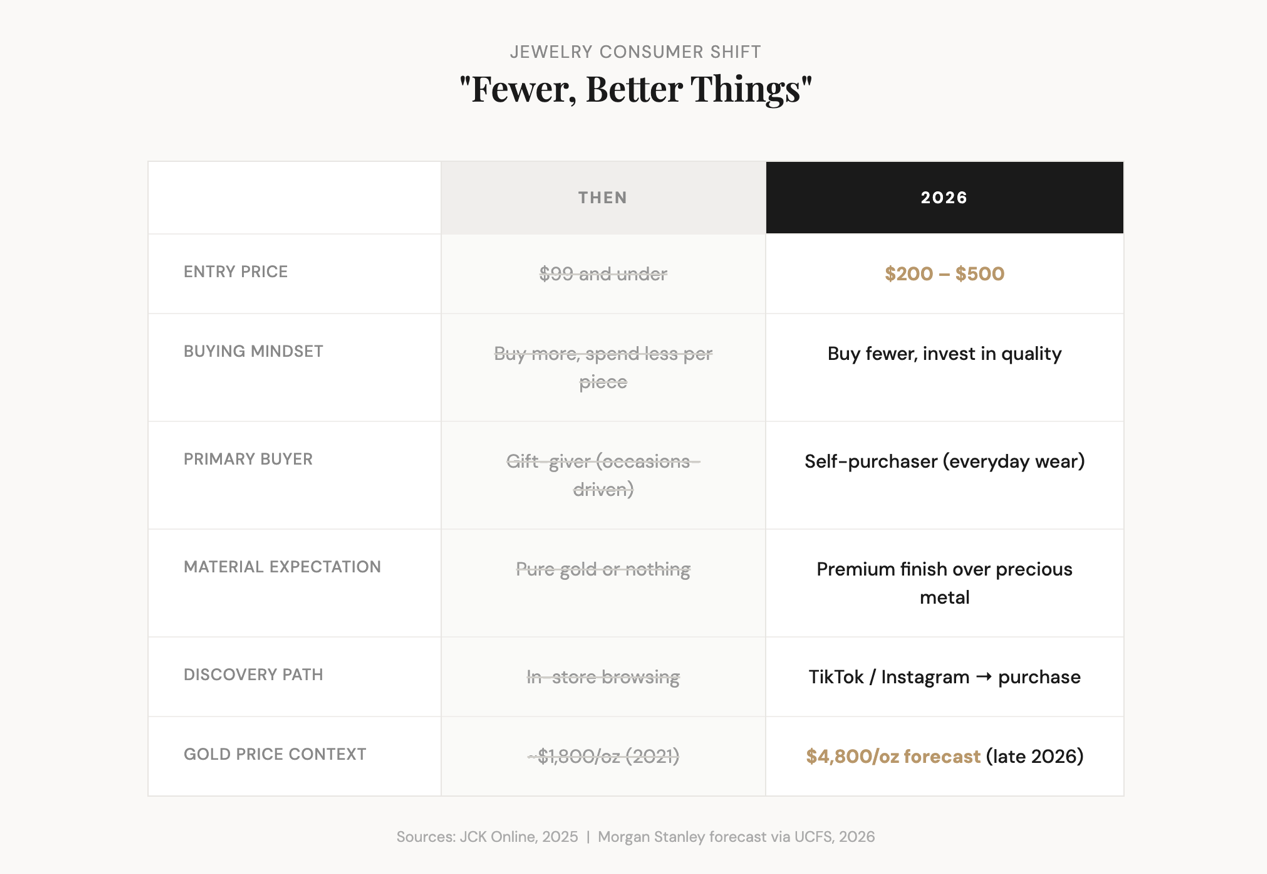
Consumptores gemmarum in 2026 plus impendunt per partem et minus volumine emunt. JCK nuntiat pretium gemmarum initium mutatum esse a priori $99 limine usque ad $200–$500, cum consumptores in pauca, alta-qualitatis item investunt potius quam in parvis pretiosis accumulando.⁴
Simul, sumptus materiarum margines comprimunt. Morgan Stanley praedicit aurum posse attingere $4,800 per unciam ad finem 2026, et venditores respondent consilio cum minus auro per partem vel compensando sumptus per strategiam pretium.⁴ ⁵
Haec coniunctio — consumptores parati ad solvendum $200–$500 pro una parte, sed aurum faciens illam pretium punctum difficilius servire cum materialibus traditionalibus — creat apertum clarum pro notis gemmarum fashionis. Alta-qualitatis PVD-coatatus chalybs inoxidabilis et electroplated brass can deliver the premium surface finish and color accuracy that this price tier demands, without the margin pressure of precious metals. The product needs to look et feel worth $300. It does not need to contain $300 worth of gold.
The Elevated Mid-Market: Where the Growth Is
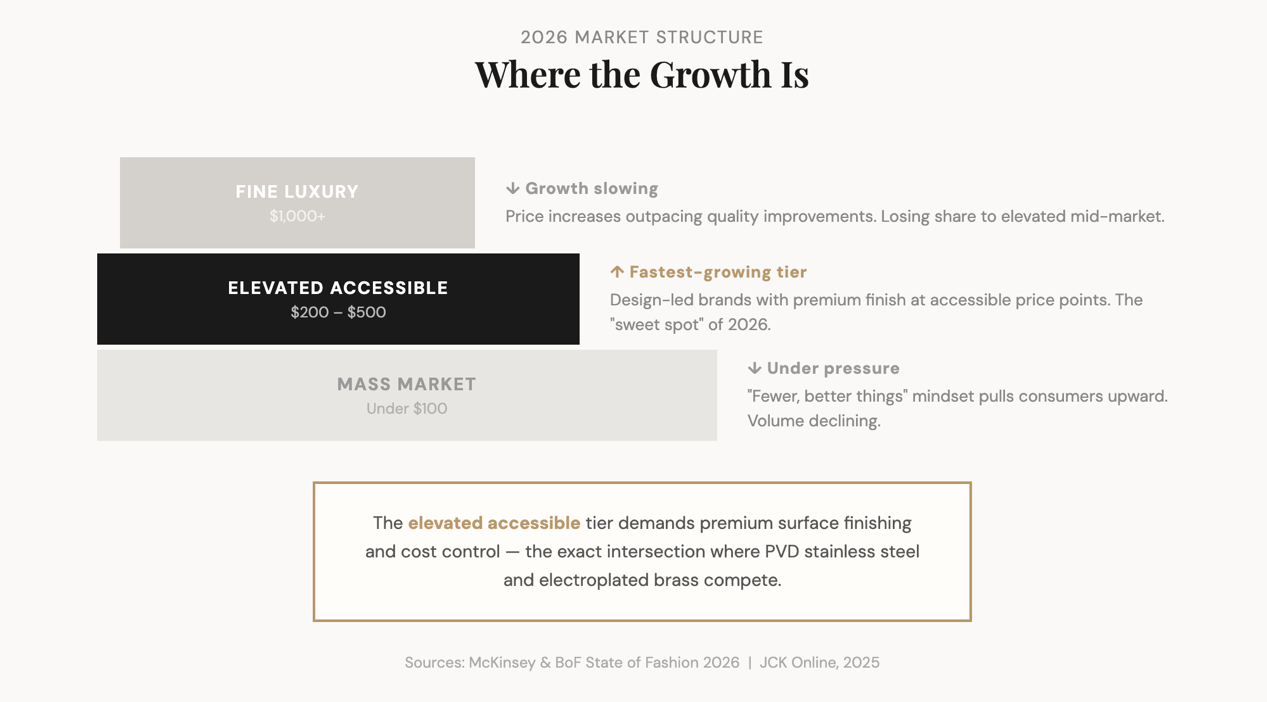
The most commercially active segment in fashion jewelry is no longer luxury. McKinsey’s 2026 report identifies the mid-market as the fastest-growing tier, replacing luxury as fashion’s primary value creator.¹ Design-led brands in this range elevated their products et retail experiences, while many luxury brands raised prices without matching improvements in quality or creativity.
JCK’s year-end analysis describes a “K-shaped economy” in which affluent consumers trend upward while middle-income households pull back.⁴ Brands that sit in the elevated mid-market — products that look premium but price below fine jewelry — are capturing both the aspirational buyer trading up et the luxury buyer looking for everyday alternatives.
The implication for jewelry manufacturers et their brand clients: surface finishing quality, plating durability, et design precision are now table stakes in this tier. A stainless steel bracelet with visible plating inconsistency or a brass ring with premature tarnishing will not survive in a market where consumers are paying $200+ et expecting longevity.
Social Commerce Is Rewriting the Purchase Path
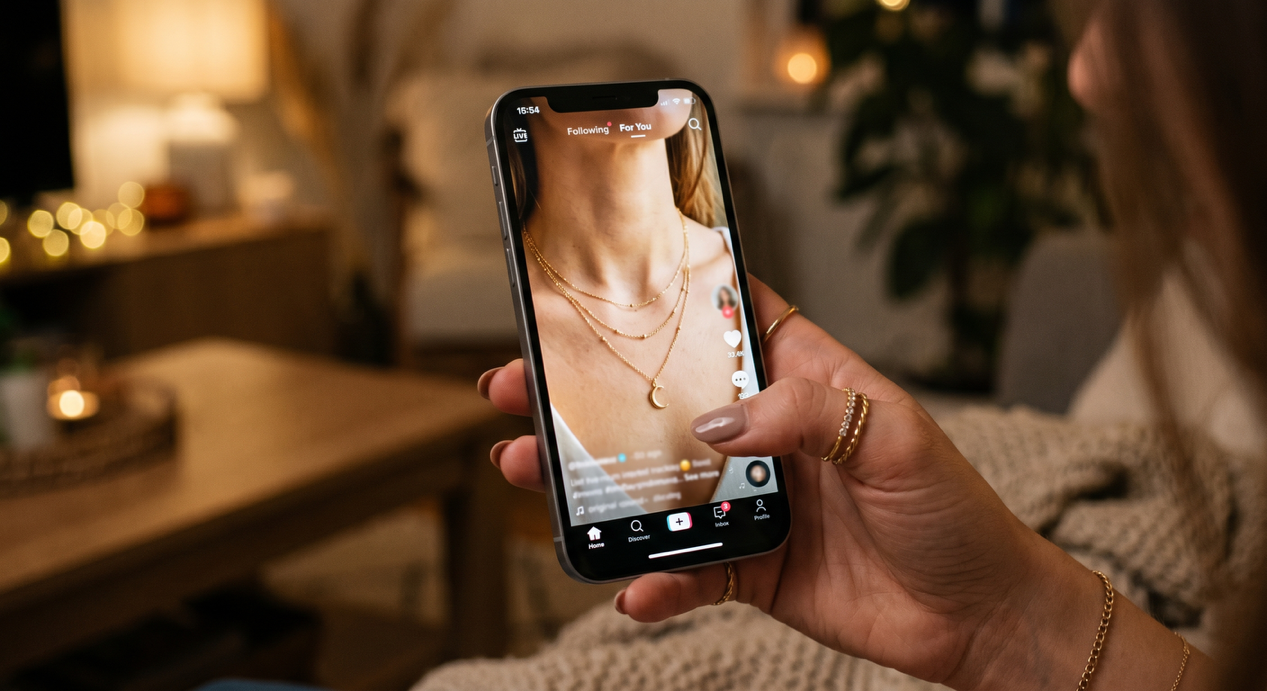
The path from discovery to purchase now runs through social media for a growing share of jewelry buyers. McKinsey notes that Gen Z exhibits a spending “duality” — frugal on clothing through thrifting et resale, but willing to indulge on jewelry et lab-grown diamonds, particularly through social-native shopping channels.¹
JCK reports that men’s jewelry is growing at 7–8% annually compared to 4–5% for women’s jewelry, a segment heavily driven by social media discovery et influencer content.² This is not a niche audience — it represents one of the fastest-expanding demographics in the category.
For brands evaluating how to market their jewelry business in 2026, the takeaway is operational, not just strategic. Products need to perform on a phone screen. A piece that reads well in a showroom but appears flat or washed-out in a 15-second video will underperform in social commerce channels. This connects directly to an underexplored area of jewelry marketing: product photography et visual content.
Jewelry Photography: The Overlooked Sales Lever
Product imagery is the primary decision driver in online et social jewelry sales. When buyers cannot touch, try on, or inspect a piece in person, the image becomes the product. Shopify’s product photography research notes that content featuring images receives 94% more views than text-only content.⁶
Yet most brand-level discussions about jewelry photography focus on the photography itself — lighting setups, model casting, editing software. The variable that gets overlooked is what happens before the camera: manufacturing quality.
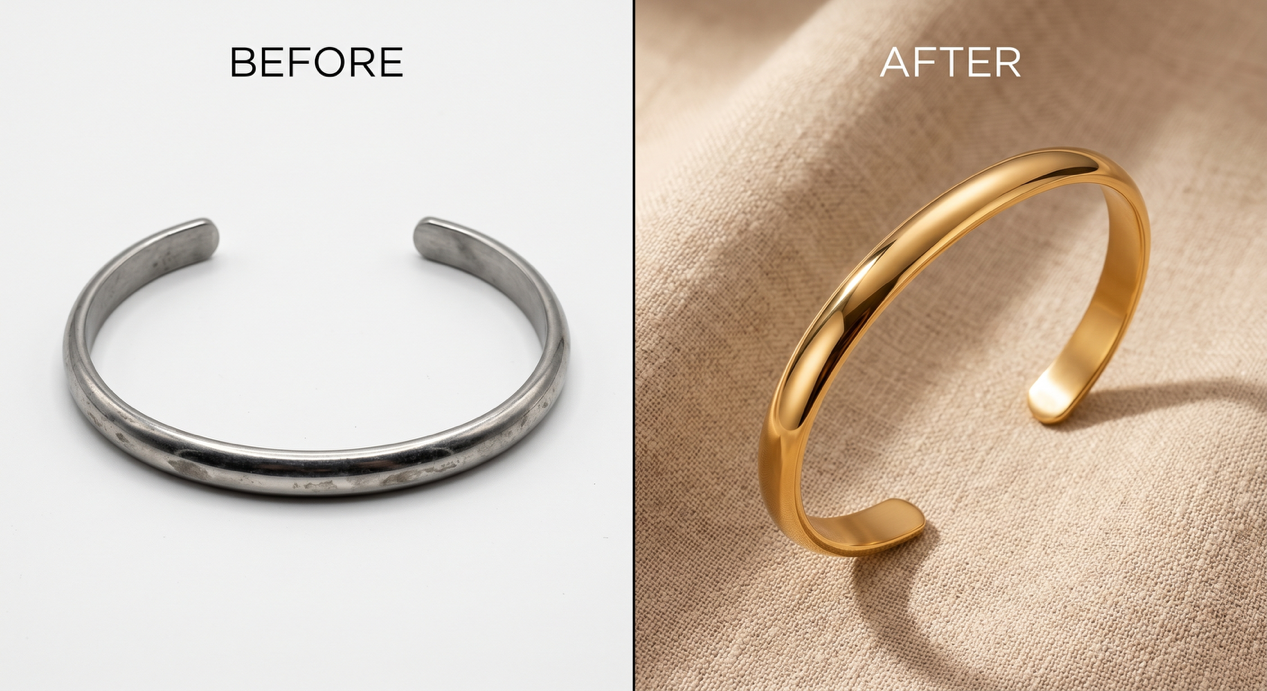
Surface finishes — mirror polish, brushed texture, PVD color tone — directly determine how a product photographs. A high-polish stainless steel bangle with even PVD coating will reflect light consistently across angles, producing clean, accurate product images. The same design with uneven plating will show color shifts and dull spots that no amount of post-production can fully correct.
AI-powered model photography tools are reducing the cost of lifestyle imagery, making professional-grade visuals accessible to smaller brands. But these tools work with the product as-is. They cannot fix a surface defect, mask a plating inconsistency, or add luster to a dull finish. Manufacturing quality is the bottleneck that determines whether a product is photogenic or not.
For brands scaling to dozens or hundreds of SKUs for social commerce, visual consistency across a product line — uniform color accuracy, predictable light behavior, consistent finish quality — becomes a measurable competitive advantage.
What This Means for Brands in 2026
2026 jewelry buyer is self-purchasing, quality-conscious, mid-market-focused, socially influenced, and visually driven. Each of these traits points to the same conclusion: the gap between a product that sells and one that sits is increasingly determined by manufacturing precision, not just design appeal.
Star Harvest’s role in this landscape is specific. PVD and electroplating processes calibrated for color accuracy produce finishes that photograph true-to-tone across lighting conditions. Flexible minimum order quantities (MOQs) allow brands to test new colorways or mixed-metal combinations in small batches before committing to full production runs. Two decades of stainless steel and brass jewelry manufacturing mean the engineering knowledge to balance wall thickness, weight, and surface finish for pieces that meet elevated mid-market expectations — on the wrist and on the screen.
References
- McKinsey & Company and The Business of Fashion. The State of Fashion 2026.McKinsey & Company, 2025.
- Bain, Marc. “Jewelry Is Fashion’s Fastest-Growing Category.” JCK Online, 2025.
- “New Survey Shows Millennials Driving America’s Jewelry Self-Purchase Trend.” BriteCo / Sterling Jewelers Blog, 2025.
- “Jewelry Retail in 2025 and 2026.” JCK Online, 2025.
- “5 Trends Shaping the Jewelry Industry and Market Outlook in 2026.” United Consumer Financial Services (UCFS), 2026.
- “The Ultimate DIY Guide to Beautiful Product Photography.” Shopify Blog, 2026.